Lives Of The Saints
June 18
St. Ephraem the Syrian
Ephraem the Syrian is the greatest poet of the early Church and the father of Christian hymnography in the East — a deacon at Edessa who wrote hundreds of hymns against heresy and in praise of the faith, and who died of plague contracted while organising care for epidemic victims.
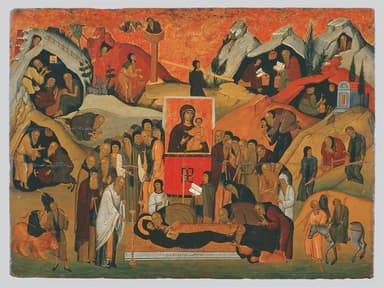
Dormition of Saint Ephraem the Syrian, Cretan icon, 15th century
Brief life
Ephraem the Syrian is the most important Christian poet before the medieval Latin tradition, and the most significant theologian to have written principally in Syriac rather than Greek or Latin. His significance extends far beyond the geography of his life: a deacon of the church at Nisibis and later at Edessa whose hymnody shaped Eastern Christian worship for centuries and whose theological poetry remains among the most substantial in the tradition.
He was born around 306, probably at Nisibis in Mesopotamia, and spent most of his active years there under Bishop Jacob of Nisibis, whom he served at the Council of Nicaea in 325. Nisibis was a frontier city, perpetually under pressure from Persia, and three Persian sieges during Ephraem's lifetime left their mark on his writings. When the Romans finally ceded Nisibis to Persia in 363, Ephraem joined the mass displacement of the Christian population to Edessa, the Syriac-speaking city in what is now southeastern Turkey, where he spent the last decade of his life.
His output was immense: hundreds of strophic hymns on the liturgical seasons, on the faith against the heretics, on the Virgin, on the patriarchs, on the pearl as an image of the soul. They were written for choirs of women, a liturgical innovation he is credited with establishing. So immediate was their popularity and so formative their effect that they became the model for Christian hymnography in the East for generations, and some found their way into the Latin liturgical tradition through translation.
He is known to have organised the care of plague victims in Edessa during the epidemic of 373, working through the city's guilds to establish a network of care for the sick and the dying. He died shortly afterward, apparently from the illness he contracted in that work. He was proclaimed Doctor of the Church by Benedict XV in 1920.
Keep reading
Nearby saint lives
Move through the calendar without leaving the saint library. These nearby feast-day lives help keep the reading trail connected.
Pray with this saint
Carry this saint into prayer
If this life stirred a particular need, keep going with the closest prayer links in the library.