Lives Of The Saints
August 18
St. Helena
Helena comes to us as Constantine's mother whose late-life pilgrimage to the Holy Land, at an age past seventy, gave Christian devotion some of its most enduring sites and relics.
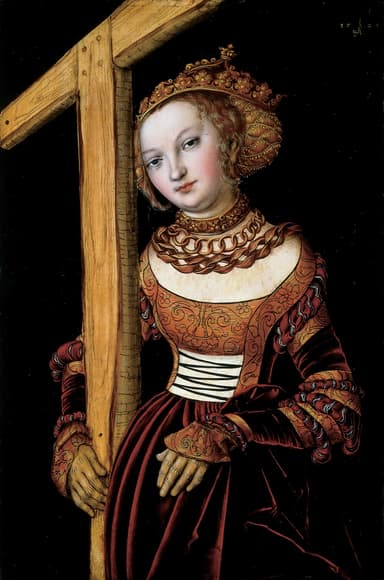
Saint Helena with the Cross, Lucas Cranach the Elder
Brief life
Helena, mother of the Emperor Constantine, is a figure whose later life is substantially better documented than her origins. She was born — the sources disagree about where, with Drepanum in Bithynia and Colchester in Britain both advanced at various points — in circumstances that were modest: the tradition calling her a stabularia, an innkeeper, may preserve a genuine memory, or may be a hostile embellishment. She became the companion of Constantius Chlorus when he was still a general in the Roman army, and bore him a son, the future Constantine, probably around 272. When Constantius was elevated to the rank of Caesar, political necessity required him to put Helena aside and marry the stepdaughter of the emperor Maximian — a transaction that requires no comment, since Helena's subsequent story belongs to a different chapter entirely.
Constantine became emperor, recalled his mother, gave her the title Augusta, and opened the resources of the imperial treasury to her charitable purposes. What followed, and what stands at the centre of her story, is the pilgrimage she made to the Holy Land around the year 326, at an age probably exceeding seventy. Constantine had already begun the basilicas at Jerusalem, Bethlehem, and Hebron; Helena went in part to oversee these projects and in part as a private pilgrim, distributing alms of remarkable generosity along the way and visiting the churches, shrines, and communities of the eastern provinces.
The discovery of the True Cross — sometimes told with the Christian Jew Judas Cyriacus directing the excavation, sometimes with Helena herself; the three crosses found together, the identification made by miraculous healing — is handled with characteristic care. The site of the Crucifixion had been covered by Hadrian with a platform and pagan temple, which may itself reflect a local memory of the place Christians venerated. What is historically certain is the figure of Helena herself: aged, genuinely devout, generous to prisoners and the poor in a way that the sources confirm from multiple directions. She died around 330.
Keep reading
Nearby saint lives
Move through the calendar without leaving the saint library. These nearby feast-day lives help keep the reading trail connected.
Pray with this saint
Carry this saint into prayer
If this life stirred a particular need, keep going with the closest prayer links in the library.