Lives Of The Saints
March 27
St. John of Damascus
John of Damascus is the last great Father of the Eastern Church — the theologian who defended the veneration of icons from outside the Byzantine Empire's reach, whose systematic Fountain of Knowledge organized Greek theology for the medieval West, and who was declared Doctor of the Church in 1890.
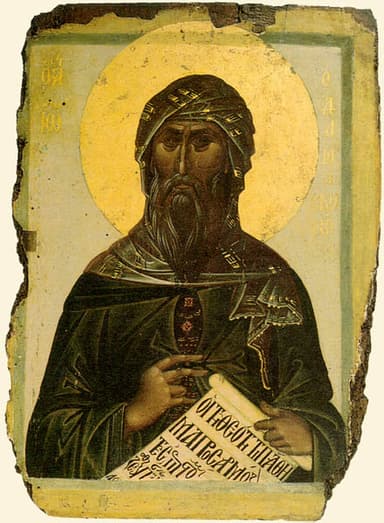
Saint John Damascene, devotional icon
Brief life
John of Damascus is the last of the great Fathers of the Eastern Church, and his significance lies less in the details of his biography — of which comparatively little is known with certainty — than in what he produced. He was born into a prominent Christian family at Damascus around 675; his father had served as a financial administrator under the Arab caliphate, and John held a similar administrative position himself for some years before resigning it and entering the monastery of St. Sabas near Jerusalem, where he spent the remainder of his life writing.
The occasion that gave his work its lasting importance was the iconoclast controversy that broke out in the Byzantine Empire in 726 when the Emperor Leo III ordered the destruction of sacred images. John could write freely against the imperial decrees precisely because he lived under Arab rule, outside the reach of Byzantine enforcement. His three treatises on the veneration of images laid out the theological defence that the Church has never substantially departed from. The distinction between the worship due to God alone (latria) and the veneration appropriate to images and to the saints (dulia and hyperdulia), the argument from the Incarnation — that God having taken a human body, the imaging of Christ in material form is not an offence against divine transcendence but a confession of it — and the appeal to consistent tradition running from the apostolic age through the Fathers: all of these are argued in the treatises with a clarity that the Council of Nicaea II in 787 effectively ratified.
But John's theological contribution is wider than the icon controversy. His Fountain of Knowledge — the Pege Gnoseos in its Greek original — organized the philosophical and theological inheritance of the Greek Fathers in a systematic form that made it available to later centuries, and through Latin translations to the theology of the medieval West, where it influenced Lombard and through Lombard the entire scholastic tradition. He was also a hymnographer of distinction. Pope Leo XIII declared him Doctor of the Church in 1890, recognising in his work the systematic achievement that the title requires.
Keep reading
Nearby saint lives
Move through the calendar without leaving the saint library. These nearby feast-day lives help keep the reading trail connected.
Pray with this saint
Carry this saint into prayer
If this life stirred a particular need, keep going with the closest prayer links in the library.