Lives Of The Saints
May 25
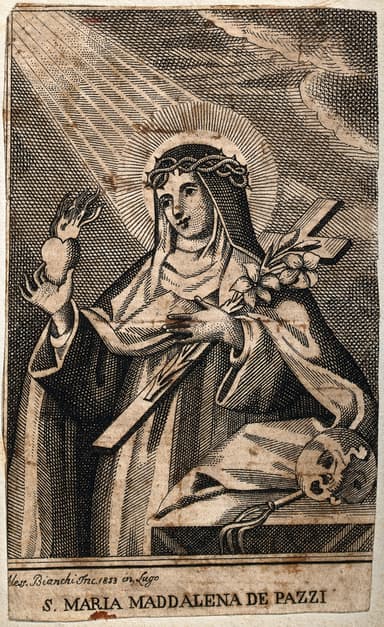
St. Mary Magdalene de Pazzi
Mary Magdalen de Pazzi was the Florentine Carmelite whose forty-day ecstatic state in 1584 was documented with unusual systematic care by the nuns who attended her, producing the theological texts known as the Colloquies.
Brief life
Mary Magdalen de Pazzi is one of the Italian Carmelite mystics of the sixteenth century whose inner life was extraordinary in its documented intensity and whose external life was entirely contained within the walls of a convent. She was born Caterina de Pazzi in Florence in 1566, of a noble Florentine family, entered the Carmelite convent of Santa Maria degli Angeli at Florence in 1582, took the name Mary Magdalen, and remained there until her death in 1607 at the age of forty-one.
The mystical experiences that began almost immediately after her entry into religious life were documented with unusual care. For forty days in 1584 she remained in a continuous ecstatic state, during which the nuns who attended her wrote down what she said. The result — the texts known as the Colloquies — preserve an interior discourse of remarkable theological depth, exploring the nature of the Trinity, the meaning of the Incarnation, the work of the Holy Spirit in the soul, in language that moved between abstract theological statement and the most immediate affective imagery. The documentation is among the most systematic produced for any mystic of the period; the nuns who witnessed and recorded were credible observers, and the theological content is consistent with the tradition.
The physical mysticism that accompanied the ecstasies — stigmata, extended periods without food, the apparent incorruption of her body at death — is handled with appropriate care: the evidence is reported as the canonization process found it, distinguishing between what the witnesses attested and what was formally defined, without pressing it beyond what it will bear. The beatification came in 1626 and the canonization in 1669. The incorrupt body at Santa Maria degli Angeli, still visible, is one of the best-attested examples of incorruption in the Italian hagiographical record.
Keep reading
Nearby saint lives
Move through the calendar without leaving the saint library. These nearby feast-day lives help keep the reading trail connected.
Pray with this saint
Carry this saint into prayer
If this life stirred a particular need, keep going with the closest prayer links in the library.