Lives Of The Saints
October 29
St. Narcissus
Narcissus of Jerusalem is perhaps the oldest bishop in the Christian historical record — the man who withdrew from his see after false accusations, lived unknown somewhere for years while three successors governed in sequence, and returned at an age Eusebius reckons as past one hundred.
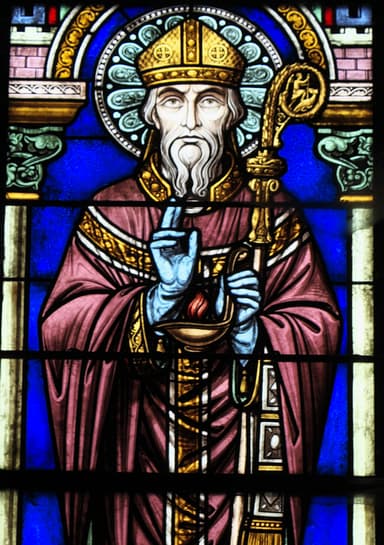
Saint Narcissus of Jerusalem, devotional stained glass
Brief life
Narcissus of Jerusalem is perhaps the oldest bishop in the Christian record of whom any biographical detail has been preserved by a credible historian. Eusebius — whose proximity to the Palestinian church gave him access to local tradition — devotes considerable attention to Narcissus in his Church History, and what he records is interesting not for its saintly conventionality but for its very unconventionality.
Narcissus was bishop of Jerusalem at the end of the second century and into the third, which already makes him an elderly man. But at some point during his episcopate — Eusebius gives the reason vaguely as the malice of certain persons who brought serious false accusations against him — Narcissus simply withdrew from Jerusalem and disappeared into the desert or some remote place where he lived as an ascetic for a long period, unknown to anyone. During his absence the Jerusalem community chose successors; three bishops served in sequence while the founder of their line was alive somewhere and uncontactable. When Narcissus returned — Eusebius says at an extreme old age, so old that the community could barely believe he was alive — the sitting bishop, Alexander, kept him as his colleague rather than displacing him.
Eusebius gives Narcissus's age at this point as over one hundred and sixteen years. The specific number need not be taken literally, but the general picture — a man of extreme old age, recognized as the legitimate bishop though he had been absent for decades — has the texture of genuine local memory rather than legend. The episode of the false accusation, the voluntary retirement, the return to a community that had moved on without him but welcomed him back: these are not hagiographical conventions. They are the events of an unusual human life, and unusual events are more credible when a good historian finds them interesting enough to record.
Keep reading
Nearby saint lives
Move through the calendar without leaving the saint library. These nearby feast-day lives help keep the reading trail connected.
Pray with this saint
Carry this saint into prayer
If this life stirred a particular need, keep going with the closest prayer links in the library.