Lives Of The Saints
January 15
St. Paul the First Hermit
Paul the First Hermit is known to us primarily through Jerome's biography, which shapes ninety years of solitude in the Theban desert into one of the most affecting stories of hidden holiness in early Christian literature.
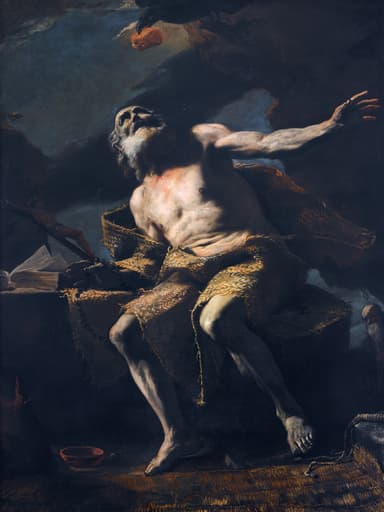
Saint Paul the Hermit, devotional painting by Mattia Preti
Brief life
The life of Paul the Hermit comes to us principally through the biography written by Jerome, which makes it at once more readable and more suspect than most early hagiography. Jerome is a literary craftsman, and the Life of Paul is shaped in part by a rhetorical purpose: to argue that Anthony of Egypt, though great, was not the first man to embrace the eremitical life in the Egyptian desert. Paul preceded him. The narrative presents Paul as a young Theban who fled into the desert during the Decian persecution around the year 250 and never returned. He found a cave shaded by a palm tree beside a spring, clothed himself with the palm's leaves, and subsisted on its fruit and on the half-loaf of bread that a raven brought to him each day — a provision that, Jerome records, had continued for sixty years before Anthony's arrival, after which the raven brought a whole loaf for two guests.
The encounter of the two old men is one of the most quietly affecting scenes in early Christian biography. Anthony, long famous and regarded as the father of Egyptian monasticism, had been told in a vision to seek out this still older and more hidden solitary. He came and found a man of extreme age who had lived entirely outside the memory of the world. Neither the Decian nor the Valerian persecutions, neither the controversies over the Nicene faith nor the rise of Constantine, had reached him; his ninety years in the cave had been occupied entirely with God. Jerome records the death of Paul at an age of perhaps one hundred and thirteen, which Anthony was granted to witness in a vision: the soul going up surrounded by angels, prophets, and apostles, blazing with a light so intense that Anthony fell to the ground.
He buried Paul in the cloak given him by Athanasius, and Jerome adds the detail of two lions who came to help dig the grave — a narrative touch belonging to the repertory of desert literature rather than to biography strictly speaking.
The Life must be read with care. Jerome's literary purposes are evident, and several of the miracle details clearly belong to a text composed for rhetorical and devotional effect. But the historical core — that certain men preceded Anthony in the Egyptian desert, that the eremitical movement had roots older than its most famous representative — seems credible. Paul represents the type of the most hidden holiness: a man whose entire life in Christ was invisible to the world, known to God alone until a very old saint came to find him at the end.
Keep reading
Nearby saint lives
Move through the calendar without leaving the saint library. These nearby feast-day lives help keep the reading trail connected.
Pray with this saint
Carry this saint into prayer
If this life stirred a particular need, keep going with the closest prayer links in the library.