Our Lady
Our Lady of Mount Carmel
Quick answer
At a glance
- What it is
- Explore the feast, history, traditional devotion, and novena of Our Lady of Mount Carmel, observed July 16.
- Often prayed for
- Marian devotions, Protection and deliverance, Virtue and perseverance, Urgent needs
- Suggested start
- Feast is July 16. The novena begins July 7.
- Feast
- July 16
- Source
- Butler, The Commemoration of Our Lady of Mount Carmel, July 16. Catholic Encyclopedia, Feast of Our Lady of Mount Carmel. Read the source standards.
The Story
The Story of Our Lady of Mount Carmel
The story of Our Lady of Mount Carmel begins on a mountain where Israel learned again that the Lord is God. On Carmel, the prophet Elijah confronted the prophets of Baal, and after the long drought his servant saw a little cloud rising from the sea. Carmelite tradition has loved that small cloud as a figure of Mary: humble in appearance, carrying mercy behind it, and bringing rain to a dry land.
Centuries later, hermits settled on Mount Carmel and lived near the places associated with Elijah. By the twelfth and thirteenth centuries they had formed a Christian community, built a chapel, and dedicated it to the Blessed Virgin. Their name carried their belonging: the Brothers of Our Lady of Mount Carmel. Before Carmel was a strong order in Europe, it was already a family under Mary.
That family nearly disappeared. When the Carmelites came west, they were poor, foreign in origin, and not easily understood. Their way of life had been born in the Holy Land, but Europe did not immediately know what to do with them. The order needed protection, approval, and a future. In that troubled season tradition places St. Simon Stock, an English Carmelite, praying to Our Lady for help.
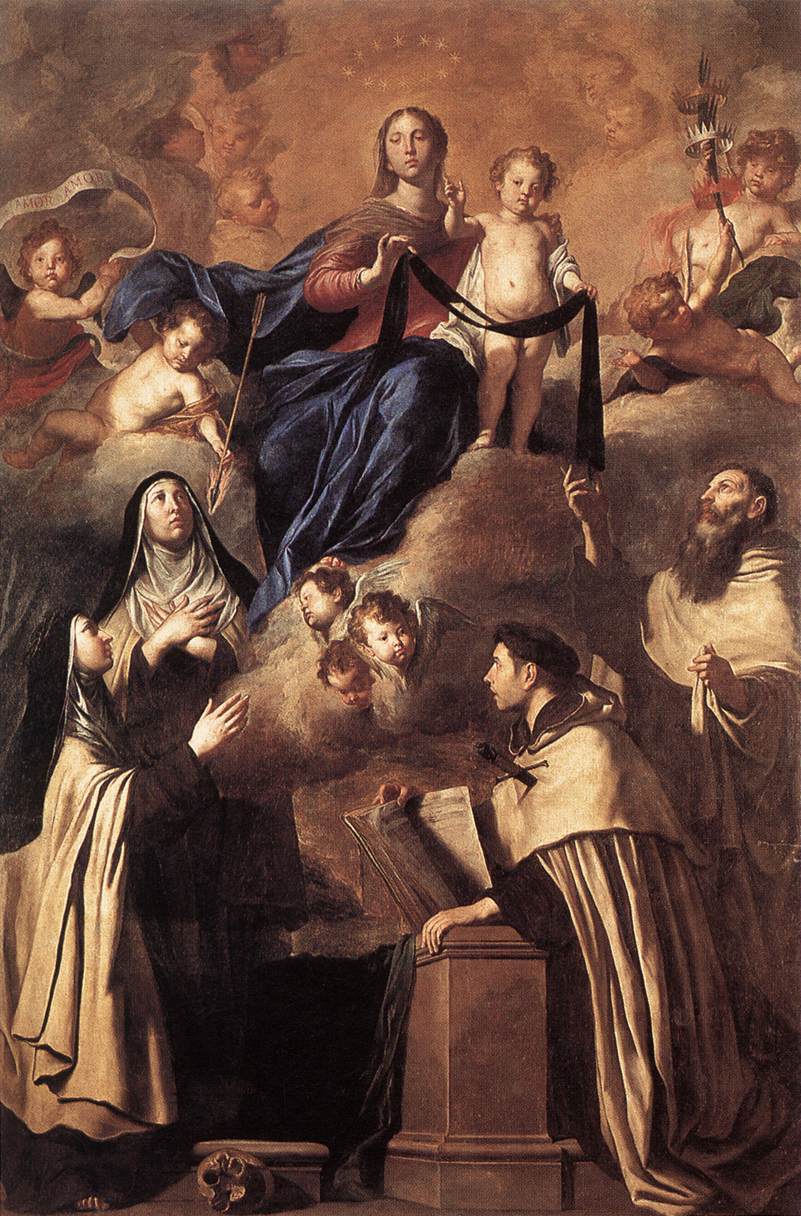
According to Carmelite tradition, on July 16, 1251, Our Lady appeared to Simon and gave him the scapular of the order, with the promise of her special protection for those who wore it faithfully. The feast of Our Lady of Mount Carmel later grew within Carmelite devotion and became closely joined to this scapular tradition. The older liturgical memory and the later devotional memory are not identical, but together they show the same confidence: Carmel belongs to Mary, and Mary does not abandon her children.
The Brown Scapular is not a charm. It is a small habit. A habit means a way of life, not merely a piece of cloth. To wear it honestly is to live as one clothed in Mary's service, seeking purity, prayer, fidelity to duty, and trust at the hour of death. The old promise is strongest when it is heard in that Catholic sense: not as magic, but as a mother's protection joined to conversion and perseverance.
The Sabbatine tradition also belongs to the history of the scapular, though it has to be stated carefully. The old bull attached to it was disputed, but the Church allowed Carmelites to preach with confidence that the faithful may trust in Our Lady's intercession, prayers, merits, and special protection for those who die in charity and have lived the devotion sincerely. That is enough. Carmel keeps a garment, a feast, and a promise, all pointing to the same thing: a mother who leads her children safely to her Son.
The Devotion
The attached practice
The principal devotion attached to this title is the Brown Scapular of Our Lady of Mount Carmel. It is worn as a sign of belonging to Mary and, through her, of renewed fidelity to Jesus Christ.
The traditional scapular devotion is tied to enrollment, a life of prayer, chastity according to one's state, and confidence in Our Lady's help at death. It should be taught as a sacramental and a habit of life, not as a mechanical guarantee.
The Intentions
Common intentions
The Novena