Lives Of The Saints
December 25
St. Anastasia of Sirmium
Quick answer
At a glance
- What it is
- Anastasia of Sirmium is commemorated in the second Mass of Christmas — the dawn stational Mass at her Palatine basilica.
- Feast
- December 25
- Source
- Butler's Lives of the Saints, Volume IV (October-November-December), December 25, St Anastasia, Martyr, Christian Classics 1990, pp. 629–631. Read the source standards.
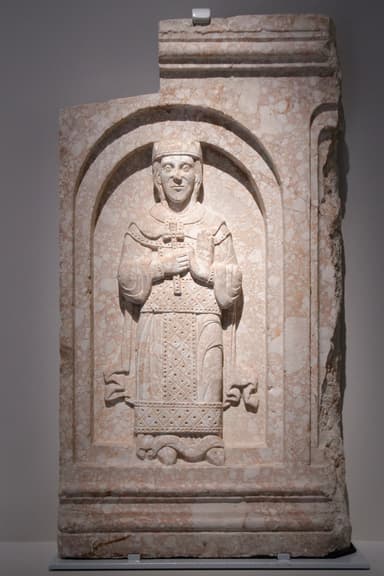
Relief of Saint Anastasia from the cathedral of Zadar
Brief life
Anastasia of Sirmium holds one of the most theologically significant positions in the entire Roman liturgical calendar: she is the martyr commemorated in the second Mass of Christmas, the Mass at dawn — the stational Mass at her basilica on the Palatine in Rome — so that for centuries her commemoration fell within the octave of the Nativity itself. This placement is liturgical evidence of exceptional antiquity and authority.
Her martyrdom is assigned to Sirmium in Pannonia — modern Sremska Mitrovica in Serbia — and the passio places it under Diocletian around 304. The account that gives her biography also gives her a companion and spiritual director in St. Chrysogonus, to whom the passio says she wrote letters from prison and who was martyred before her. The church at Rome dedicated to Chrysogonus in Trastevere is one of the oldest titular churches in the city. The connection between the two saints through the passio and through their Roman basilicas is Roman topographical evidence more reliable than the biographical narrative itself.
The name Anastasia means resurrection in Greek, and the placement of her commemoration at the Christmas dawn Mass generated centuries of reflection on the connection between the birth of Christ and the resurrection that his birth makes possible. The typological connection is not pressed too hard — the symbolism cannot generate biography — but it is one of the reasons the Roman liturgy may have settled on this particular martyr for this particular moment in the Christmas celebration.
Her relics, translated from Sirmium to Constantinople in the fifth century and later distributed more widely, gave her cult a reach across both Eastern and Western churches that few martyrs of the Pannonian region achieved. The Eastern church venerates her as one of the great-martyrs. Confidence in her cult rests on the antiquity of the Roman stational commemoration and on the basilica that preserves her name on the Palatine.
Next step
St. Anastasia of Sirmium Novena
A novena connected to this saint is in the library.
Keep reading
Nearby saint lives
Move through the calendar without leaving the saint library. These nearby feast-day lives help keep the reading trail connected.
Pray with this saint
Carry this saint into prayer
If this life stirred a particular need, keep going with the closest prayer links in the library.