Lives Of The Saints
November 30
St. Andrew the Apostle
Andrew is remembered less for his own prominence in the Gospels than for what he did first: he found his brother Peter and brought him to Christ.
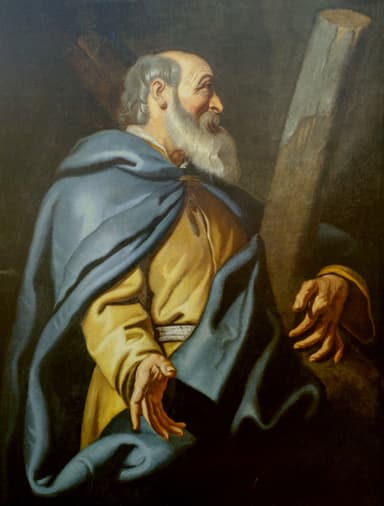
Saint Andrew, Gerard Seghers
Brief life
Andrew appears chiefly as the one who came first and pointed others to Christ. He had been a disciple of the Baptist before he followed Jesus, and it is Andrew whom the fourth Gospel shows bringing his brother Simon to the Lord the day after the call. That act of leading Peter to Christ is what deserves attention most carefully: Andrew is not the most prominent of the apostles in the Gospel narrative — he stands somewhat in the shadow of his brother — but the significance of what he does is incalculable. He brings to Christ the one who will become the rock on which the Church is built. The pattern of bringing others to Jesus appears again at the feeding of the five thousand, where it is Andrew who presents the boy with the five loaves and two fish, and again when it is Andrew and Philip together who bring the Greeks to the Lord.
Later tradition and the Acts of Andrew fill in a wider apostolic mission, mainly in the region of Scythia, Achaia, and Greece. These traditions are legendary in character, and the old accounts are preserved as such: Andrew preached widely, made many converts, and was finally brought before the proconsul Aegeas at Patras. His martyrdom on the X-shaped cross — the form now called the cross of St. Andrew — is one of the most storied in all the early martyr literature. The long speech that Andrew is said to have addressed to the cross before his death is almost certainly legendary in its present form, but it captures something true about the disposition of a martyr who regarded the cross not with fear but with the desire of a lover. The relics were translated to Constantinople, and later parts passed to Amalfi and to Scotland, which chose him as its patron.
Keep reading
Nearby saint lives
Move through the calendar without leaving the saint library. These nearby feast-day lives help keep the reading trail connected.
Pray with this saint
Carry this saint into prayer
If this life stirred a particular need, keep going with the closest prayer links in the library.