Lives Of The Saints
April 21
St. Anselm
Anselm of Canterbury is both the philosopher who wrote the ontological argument and the Cur Deus Homo at Bec, and the archbishop who twice went into exile rather than compromise on investiture.
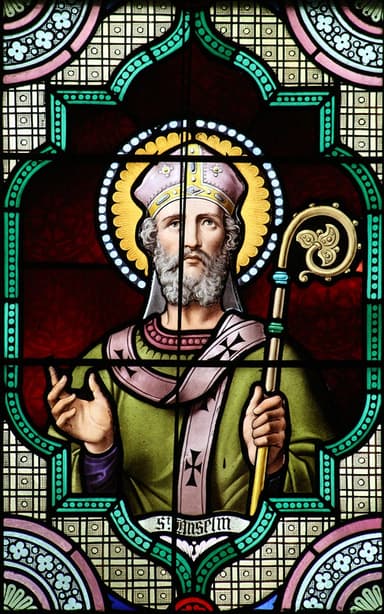
Saint Anselm of Canterbury, devotional image
Brief life
Anselm of Canterbury is one of the great intellectual figures of the medieval Church and one of the most consequential archbishops in English ecclesiastical history, and both dimensions of his life deserve serious attention. He was born at Aosta in Piedmont around 1033, the son of a Lombard nobleman, and after a period of wandering entered the monastery of Bec in Normandy under the great Lanfranc. He became prior of Bec in 1063 and abbot in 1078, and it was during these years at Bec that he produced the works that secured his place in the history of thought: the Monologion, the Proslogion with its ontological argument for the existence of God, the Cur Deus Homo on the theology of the Atonement.
His appointment as Archbishop of Canterbury in 1093 by William Rufus ended the intellectual tranquillity of Bec permanently. The Investiture Controversy — the struggle over whether secular rulers could invest bishops with the symbols of their spiritual office — brought Anselm into direct collision with both William Rufus and Henry I, and produced two periods of exile from England. These controversies represent a genuine constitutional struggle between the papacy's claim to govern the Church and the crown's claim to control its senior officers, and Anselm's consistent refusal to compromise — at genuine personal cost, in circumstances where compromise would have been easy — is the specific expression of his holiness in the episcopal life. He did not flee controversy; he walked into it because the principle at stake required it.
He died in 1109 and was declared Doctor of the Church in 1720.
Keep reading
Nearby saint lives
Move through the calendar without leaving the saint library. These nearby feast-day lives help keep the reading trail connected.
Pray with this saint
Carry this saint into prayer
If this life stirred a particular need, keep going with the closest prayer links in the library.