Lives Of The Saints
October 24
St. Anthony Mary Claret
Anthony Mary Claret was a nineteenth-century Catalan who brought the same ferocious energy to mission work in rural Catalonia, an archdiocese in Cuba, the royal court of Isabella II, and the First Vatican Council.
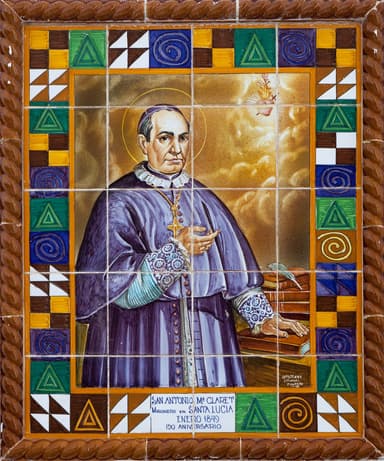
Saint Anthony Mary Claret, tile image in Santa Lucia de Tirajana
Brief life
Anthony Mary Claret was one of the most energetic figures of nineteenth-century Spanish Catholicism — priest, founder, archbishop, royal confessor, and finally an exile who spent his last years defending the faith at the First Vatican Council. The energy is the consistent note across every phase of his life.
He was born in 1807 at Sallent in Catalonia, the son of a weaver, and was ordained in 1835 after a period as a weaving apprentice and a brief attempt to enter the Jesuits, which his health prevented. His early years of mission work in Catalonia established the pattern: incessant preaching across the rural districts, founding schools and lending libraries, using the printing press as a missionary tool — he founded the Religious Publishing House of Barcelona and wrote or edited over two hundred books and pamphlets in the course of his life. He founded the Congregation of the Missionary Sons of the Immaculate Heart of Mary — the Claretians — in 1849, specifically to sustain this kind of active apostolate after he could no longer personally conduct it.
Then, in 1850, came the appointment he had neither sought nor wished: Archbishop of Santiago de Cuba, where the Church was in serious disorder after decades of administrative neglect and political upheaval. Six years of genuine reform followed. He reorganized the parishes, founded schools, encouraged the religious life, and preached with the same directness that had served him in Catalonia. He also survived an assassination attempt in 1856 that left his hand partially disabled, severing tendons in his right wrist.
Queen Isabella II called him back to Spain in 1857 as her confessor, a position he held until the revolution of 1868 drove her into exile. Claret went with her to France and spent his final years writing, attending the First Vatican Council in 1869 and 1870, and defending Pius IX's definition of papal infallibility against the organized opposition. He died at the Cistercian monastery of Fontfroide in 1870 and was canonized in 1950.
Keep reading
Nearby saint lives
Move through the calendar without leaving the saint library. These nearby feast-day lives help keep the reading trail connected.
Pray with this saint
Carry this saint into prayer
If this life stirred a particular need, keep going with the closest prayer links in the library.