Lives Of The Saints
March 6
St. Colette
Quick answer
At a glance
- What it is
- Colette of Corbie reformed the Poor Clares back to the primitive rule of absolute poverty and strict enclosure at a moment.
- Feast
- March 6
- Source
- Butler's Lives of the Saints, Volume I (January-February-March), March 6, St Colette, Virgin, Christian Classics 1990, pp. 476–479. Read the source standards.
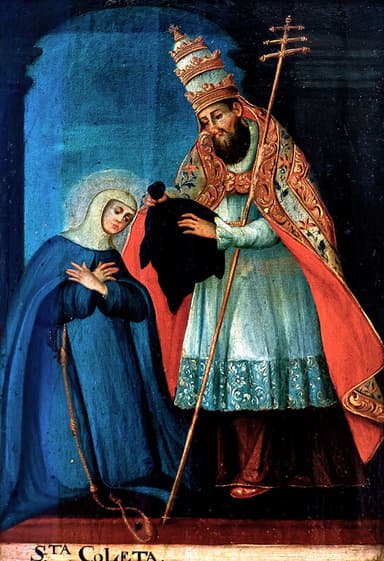
Saint Colette, anonymous painting, Museo Nacional de Bellas Artes de Cuba
Brief life
Colette of Corbie was a reformer of the Franciscan order — specifically of the Poor Clares, whose original rule of absolute poverty and strict enclosure had been substantially softened during the century and a half since Clare of Assisi had established it. Colette was born in 1381 at Corbie in Picardy, the daughter of a carpenter attached to the Abbey of Corbie. Orphaned early, she tried various forms of religious life, was refused by several communities, and lived for a time as a recluse in a cell attached to a church. Then she was professed as a Franciscan tertiary by the minister general of the order, Peter de Luna — who was at that moment the anti-pope Benedict XIII, a fact that requires no embarrassment to note: Colette's cause required his authority, and the Great Schism created many such practical entanglements — and from that moment she began the work that would define her life.
The work was the restoration of the Poor Clares to the rule of Clare herself: absolute poverty, strict enclosure, perpetual fasting, the coarsest possible habit, the full austerity of the primitive observance which many houses had long since quietly abandoned. What Colette accomplished against the backdrop of the Western Schism and against the practical resistance of established communities is, even on a secular accounting, remarkable. She eventually reformed or founded more than thirty convents, drawing women into a stricter life they had sought voluntarily. The opposition she faced was continuous, both institutional and personal — she was refused, mocked, obstructed, and publicly doubted — and she continued through all of it with the equanimity characteristic of the genuine reformer.
She died at Ghent in 1447 and was canonized in 1807. The Colettine Poor Clares, the branch of the order she reformed, persist to the present day, observing the rule of poverty she restored.
Next step
St. Colette Novena
A novena connected to this saint is in the library.
Keep reading
Nearby saint lives
Move through the calendar without leaving the saint library. These nearby feast-day lives help keep the reading trail connected.
Pray with this saint
Carry this saint into prayer
If this life stirred a particular need, keep going with the closest prayer links in the library.