Lives Of The Saints
May 14
St. Corona
Quick answer
At a glance
- What it is
- Victor and Corona were an ancient martyr pair whose passio is largely legendary but whose cult in both Eastern and Western churches has genuine early roots.
- Feast
- May 14
- Source
- Butler's Lives of the Saints, Volume II (April-May-June), May 14, SS Victor and Corona, Martyrs, Christian Classics 1990, pp. 303–305. Read the source standards.
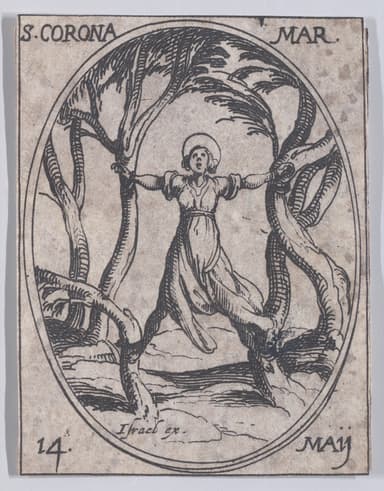
Saint Corona, martyr, devotional image
Brief life
Victor and Corona are commemorated together, though their stories as the passio tells them are distinct. Victor was a soldier, the passio says, a Roman Christian who refused to sacrifice during the Antonine or Diocletianic persecutions — the accounts vary — and was tortured and executed at Apamea in Syria. Corona was the wife of another soldier present at the torture; seeing Victor's endurance, she declared herself a Christian and was immediately martyred by a method the passio describes with graphic detail.
The passio belongs to the genre of martyr literature in which historical kernels are regularly overlaid with legendary elaboration, and the specific narrative details — the ages of the martyrs, the forms of execution, the dialogue between Corona and Victor — cannot be taken as reliable biography. The historical foundation that holds is this: an early Christian cult developed at their tomb, the church at Feltre in northern Italy housed relics attributed to them from a very early date, and both the Eastern and Western churches commemorated them, which provides some evidence of antiquity.
The veneration of Corona as a patron invoked in times of plague, epidemic, and financial distress has ancient roots in central European devotion, particularly in German-speaking regions. The specific geographic concentration of the cult — the relics at Aachen were among the most venerated in the Carolingian church — is not a mark against its validity. Many genuine early cults were regionally specific before becoming universal.
The more theologically interesting element in the tradition is the structure of Corona's martyrdom: a bystander converted by the spectacle of another's endurance, who then immediately accepts her own death without a period of instruction or preparation. It is one of the purest forms of martyr literature — the witness who becomes a martyr before she becomes a catechumen — a theological statement about what the blood of martyrs accomplishes.
Next step
St. Corona Novena Against Pandemics
A novena connected to this saint is in the library.
Keep reading
Nearby saint lives
Move through the calendar without leaving the saint library. These nearby feast-day lives help keep the reading trail connected.
Pray with this saint
Carry this saint into prayer
If this life stirred a particular need, keep going with the closest prayer links in the library.