Lives Of The Saints
May 15
St. Dymphna
Quick answer
At a glance
- What it is
- Dymphna is a young martyr whose medieval passio must be handled with caution.
- Feast
- May 15
- Source
- Butler's Lives of the Saints, Volume II (April-May-June), May 15, St Dymphna, Christian Classics 1990, pp. 311-313. Read the source standards.
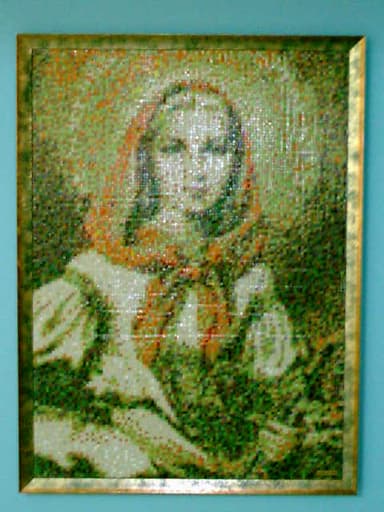
Saint Dymphna mosaic, Guillaume Brie of Geel
Brief life
Dymphna's story reaches us through a medieval passio, a written account of her life and death composed in the thirteenth century by Pierre, a canon of the church of Saint Aubert at Cambrai. He drew on local oral tradition that was already old in his own day. Because the account was written down long after the events it describes, its historical details deserve caution. Yet the tradition it preserved has shaped Christian devotion and the history of compassionate care in ways that are very real.
According to the narrative, Dymphna was born in the seventh century, the daughter of a petty king or chieftain in Ireland. Her mother was a devout Christian, and Dymphna was baptized and raised in the faith, consecrating herself to Christ in her youth. Her father is remembered as a pagan, or at least as a man whose conversion was unstable.
When Dymphna's mother died, her father was consumed by grief. His counselors urged him to remarry, and he agreed only if they could find a woman as beautiful as his late wife. None could be found. In his disordered sorrow, his attention turned to Dymphna herself, who resembled her mother, and he pressed his own daughter to marry him.
Dymphna fled in horror. She was accompanied by her confessor, the priest Gerebernus, and by a small company that tradition names as including the court jester and his wife. They crossed the sea and traveled through the Low Countries, eventually settling near Gheel, in what is now the Antwerp province of Belgium. There Dymphna is said to have built a small oratory and given herself to prayer, the poor, and the sick.
Her father pursued her. Tradition says he traced the company by coins they had spent along the way and found them at Gheel. He ordered his men to kill Gerebernus, and the priest was put to death. Then he demanded again that Dymphna return with him and submit to his will. She refused. In a rage, he drew his sword and beheaded her himself. Tradition holds that she was about fifteen years old.
For centuries Dymphna's grave remained a local memory. Around the thirteenth century, two tombs were uncovered at Gheel and identified as those of Dymphna and Gerebernus. Reports of healing soon drew pilgrims, and a church dedicated to Saint Dymphna was raised on or near the site. Gerebernus came to be venerated as a saint in his own right, and his relics were later moved to Sonsbeck in Germany.
The healings reported at Dymphna's shrine clustered around a particular kind of suffering: mental illness, nervous and emotional disorders, and epilepsy. In art she is often shown as a young woman with a sword, a lily for purity, and a chained demon at her feet, a sign of her intercession against the torments of the mind.
What makes Gheel extraordinary is not only the shrine but what grew up around it. Pilgrims came seeking relief for afflicted loved ones. Many who came either recovered or needed a safe place to remain. Over time, the people of Gheel began taking these visitors into their own homes, boarding them with ordinary families on the farms of the surrounding countryside.
This practice endured for centuries and became famous across Europe. Rather than confining the mentally ill in isolation, the families of Gheel lived alongside them, sharing meals, work, and daily life. The system continued into the modern era and is still studied as one of the earliest and most humane models of community psychiatric care. What began as religious hospitality became a long witness to treating the afflicted with dignity rather than fear.
Dymphna is honored as the patron of those who suffer from mental illness, anxiety, depression, and epilepsy, and also of victims of abuse and those driven from their homes. Whether or not every detail of the medieval account is historically certain, something genuine took root at Gheel. Out of one young woman's refusal to betray her faith and conscience grew one of the Church's most distinctive witnesses: that those whose minds are afflicted are not to be cast aside, but received, sheltered, and loved.
Historical note
This life notes that the passio of St. Dymphna rests on material of uncertain historical value.
The public text also notes the thirteenth-century passio tradition and the later Gheel model of family-based care.
Next step
Novena to St. Dymphna
A novena connected to this saint is in the library.
Keep reading
Nearby saint lives
Move through the calendar without leaving the saint library. These nearby feast-day lives help keep the reading trail connected.
Pray with this saint
Carry this saint into prayer
If this life stirred a particular need, keep going with the closest prayer links in the library.
Related novena
Novena to St. Dymphna
Faith, hope, courage against sin, endurance in poverty, and strength in pursuing eternal salvation.
Open the novena
Related novena
St. Dymphna Novena - Prayers for Mental Illnesses
Prayed for mental and nervous afflictions, consolation, patience in suffering, hope, and relief for troubled minds.
Open the novena