Lives Of The Saints
September 20
St. Eustace
Eustace was one of the most openly legendary of the Fourteen Holy Helpers — the converted Roman general who sees a stag with a crucifix between its antlers and then loses everything before dying with his family in a brazen bull.
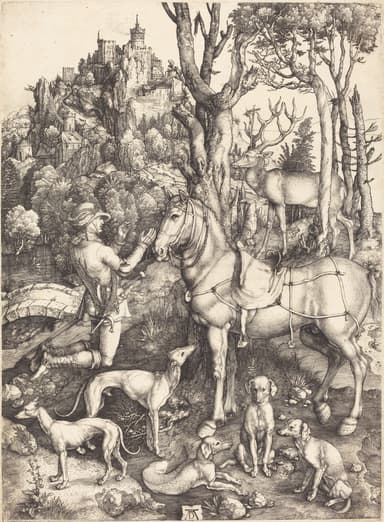
Saint Eustace, Albrecht Durer, c. 1500-1501
Brief life
Eustace — also called Eustachius or Hustachio — is one of the Fourteen Holy Helpers and one of the most clearly legendary of all the widely-venerated early martyrs, and this must be said plainly. The passio that gives him a biography is a literary composition belonging to the genre of the converted general, a narrative type with classical and Eastern antecedents in which a Roman military commander undergoes a dramatic conversion and is subsequently martyred with his family. In Eustace's version, the conversion occurs by means of a vision while hunting: a stag appears bearing a crucifix between its antlers and speaks in Christ's voice. The same vision is assigned to St. Hubert of Liège, whose feast day falls not long after Eustace's.
The subsequent narrative — separation from his wife and sons by a series of disasters, their eventual reunion, the refusal to sacrifice under Hadrian, and the martyrdom of the whole family enclosed in a brazen bull — is popular religious romance of considerable literary sophistication attached to a name with no clear historical referent. There is no early inscription, no Roman topographical evidence, no martyrology entry that predates the passio itself with independent authority.
And yet Eustace was one of the most universally invoked of the Holy Helpers, particularly for those facing desperate situations, because the structure of his legendary life — the loss of everything, the patient endurance, the eventual restoration that came too late to prevent the final catastrophe — resonated with a medieval imagination deeply formed by Job. The legend of Eustace is the story of Job in the key of Roman military biography, and its enormous popularity rests on that structural resonance rather than on biographical fact.
Keep reading
Nearby saint lives
Move through the calendar without leaving the saint library. These nearby feast-day lives help keep the reading trail connected.
Pray with this saint
Carry this saint into prayer
If this life stirred a particular need, keep going with the closest prayer links in the library.