Lives Of The Saints
February 4
St. John de Britto
Quick answer
At a glance
- What it is
- John de Britto was a Portuguese Jesuit who adopted the Madurai method of Hindu holy-man dress and practice.
- Feast
- February 4
- Source
- Butler's Lives of the Saints, Volume I (January-February-March), February 4, St John de Britto, Martyr, Christian Classics 1990, pp. 248–251. Read the source standards.
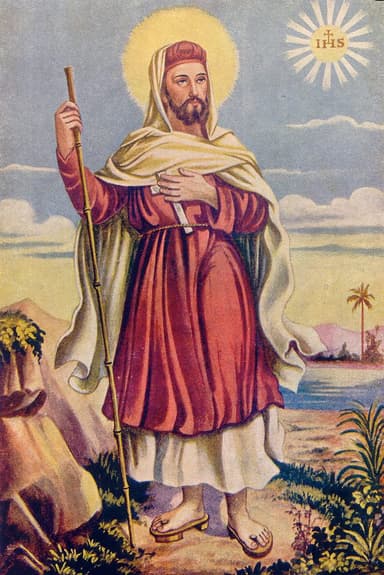
Saint John de Britto (1647–1693), Jesuit martyr of India
Brief life
John de Britto is one of the Jesuit martyrs of India, born in Lisbon in 1647 into a noble family with connections to the Portuguese royal court, and he belongs to the specific tradition of the Madurai mission that Roberto de Nobili had pioneered: the attempt to reach the Hindu upper castes by adopting the dress, diet, and social practices of the sanyasi — the Hindu holy man — rather than identifying Christianity with Portuguese colonial culture.
He arrived in India in 1673 and threw himself into the Madurai method with conviction. He adopted ochre robes, lived on rice and vegetables, learned Tamil, and moved through the caste system as a holy man rather than as a European priest. His effectiveness was real: he made converts across several decades, established Christian communities in areas previously unreached, and was arrested and tortured on two occasions before the final martyrdom. His first arrest and torture in 1686 produced a period of imprisonment followed by expulsion rather than death; the Portuguese ambassador's intervention secured his release, and he returned to Portugal for several years before going back to India in 1690.
The final episode that led to his death was specific. One of the local rajas, Ragunadasuppoa, had a nephew named Tadya Tevar who converted under Britto's ministry and dismissed his concubines in consequence. The dismissed women appealed to the raja, who had Britto arrested. Britto refused to leave India, refused to apostatize, and refused to accept release when it was offered. He was beheaded at Oriyur on February 4, 1693. He was canonized in 1947. His death represents the pattern of the Jesuit martyr most perfectly realized: killed not for what he believed in the abstract but for what his converts were prepared to give up in the concrete.
Next step
Browse the novena library
Browse the broader library if you want to move from reading into prayer.
Keep reading
Nearby saint lives
Move through the calendar without leaving the saint library. These nearby feast-day lives help keep the reading trail connected.
Pray with this saint
Carry this saint into prayer
If this life stirred a particular need, keep going with the closest prayer links in the library.