Lives Of The Saints
January 16
St. Marcellus I
Quick answer
At a glance
- What it is
- Marcellus I is one of the most honestly uncertain early popes — a bishop who may have lapsed under Diocletian.
- Feast
- January 16
- Source
- Butler's Lives of the Saints, Volume I (January-February-March), January 16, St Marcellus I, Pope and Martyr, Christian Classics 1990, pp. 100–102. Read the source standards.
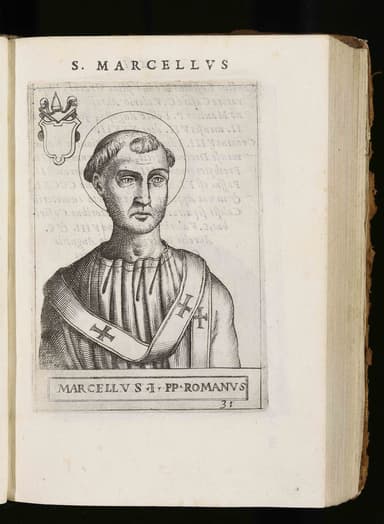
Brief life
Marcellus I is one of the more honestly complicated figures in early papal history, because the story attached to his name during the Diocletian persecution raises a question that cannot be fully resolved. He was bishop of Rome from around 307 and died in 309 — a reign shorter than it appears, because for some interval there was no bishop at all in Rome during the most severe phase of the persecution. The bishop who preceded him, Marcellinus, was the subject of a charge of apostasy that the Donatists preserved with evident relish; and something of the same shadow fell on Marcellus.
The serious charge, preserved in hostile sources, was that Marcellus had at some point either handed over sacred books or offered incense to the gods under pressure from the persecuting authorities. The Donatists, who made the most of this charge, were not neutral witnesses; a Roman synod held under Marcellus appears also to have imposed severe canonical penance on those who had lapsed, a practice that might include Marcellus himself in the ranks of those requiring penance. The more dramatic version of the story — that the synod condemned him personally, and that he served out his penance working as a groom in a stable belonging to a wealthy woman named Lucina — is probably legendary, shaped by the penitential literature of the period.
What survives is the evidence of the early inscription in the cemetery of Priscilla, which calls Marcellus bishop and martyr. If he had lapsed — and the question cannot be answered definitively — he appears to have made amends through genuine suffering afterward, in the manner of the lapsi who sought to repair their failures through confession and sometimes through a second martyrdom. The Roman church's judgment, expressed in that early inscription and in his continued place in the calendar, was that whatever had happened, Marcellus had died for the faith. That judgment stands, while the uncertainty that surrounds his middle years remains real.
Next step
Novena to Saint Pope Marcellus I
A novena connected to this saint is in the library.
Keep reading
Nearby saint lives
Move through the calendar without leaving the saint library. These nearby feast-day lives help keep the reading trail connected.
Pray with this saint
Carry this saint into prayer
If this life stirred a particular need, keep going with the closest prayer links in the library.