Lives Of The Saints
July 20
St. Margaret of Antioch
Quick answer
At a glance
- Who is this saint?
- St. Margaret of Antioch is honored as a virgin and martyr and is also known as Marina. Her memory has been cherished for centuries, especially by expectant mothers. Her traditional Latin feast is July 20.
- Feast
- July 20
- Brief life source
- Butler's Lives of the Saints, Volume III (July-August-September), July 20, St Margaret, or Marina, Virgin and Martyr, Christian Classics 1990, pp. 143–145. Read the source standards.
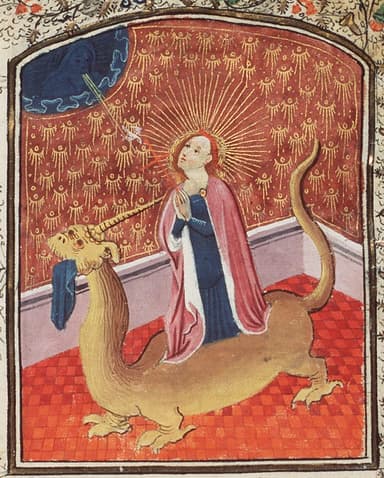
Saint Margaret of Antioch, illuminated manuscript, c. 1440
Brief life
St. Margaret of Antioch, known in the Eastern tradition as St. Marina, has been honoured for centuries as a virgin martyr. Her traditional life tells of a young Christian who refused the governor Olybrius, endured imprisonment and torture, and met the devil in the image of a dragon. The details come through a late devotional account rather than a contemporary record; its enduring heart is clear: Margaret chose fidelity to Christ rather than surrender.
Her veneration spread early and widely. She is numbered among the Fourteen Holy Helpers, and her name was one of the three, with St. Michael and St. Catherine of Alexandria, that St. Joan of Arc said she heard during her trial at Rouen. Christians in both East and West have kept her memory as a witness of courage, purity, and steadfast faith.
The dragon in St. Margaret's story is a spiritual image of evil's apparent power. Her deliverance recalls that nothing can finally swallow a soul kept in Christ. Her feast invites us to ask for courage when fidelity is costly, purity of heart, and trust in Christ's victory over every fear.
Questions about this saint
Which Antioch is associated with St. Margaret?
Her traditional account places her at Antioch in Pisidia, in Asia Minor. This is distinct from Antioch in Syria, another city important in early Christian history.
Why is St. Margaret also called Marina?
The older Catholic Encyclopedia records her Eastern veneration under the name Marina or Marine and her Latin veneration as Margaret. The names refer here to the same virgin martyr.
What do the older sources say about her history?
The 1910 Catholic Encyclopedia notes that even the century of her life is uncertain, although her Acts place her in the persecution of Diocletian. Her long veneration and familiar artistic emblems should be distinguished from a securely dated biography.
Source for these reading notes
The introduction and answers are Novena Regina editorial summaries of the older reference below. The brief life above has its own source citation at the top of the page.
Joseph MacRory, “St. Margaret,” The Catholic Encyclopedia, vol. 9 (1910), transcribed at New Advent
Next step
Pray the St. Margaret of Antioch novena
Open the novena and its source notes, then choose when to begin.
Keep reading
Nearby saint lives
Move through the calendar without leaving the saint library. These nearby feast-day lives help keep the reading trail connected.
Pray with this saint
Carry this saint into prayer
If this life stirred a particular need, keep going with the closest prayer links in the library.