Lives Of The Saints
December 13
St. Odilia
Quick answer
At a glance
- What it is
- Odilia is the patron of Alsace whose foundational legend — born blind, sight restored at baptism, reconciled with a cruel father.
- Feast
- December 13
- Source
- Butler's Lives of the Saints, Volume IV (October-November-December), December 13, St Odilia, Virgin and Abbess, Christian Classics 1990, pp. 546–548. Read the source standards.
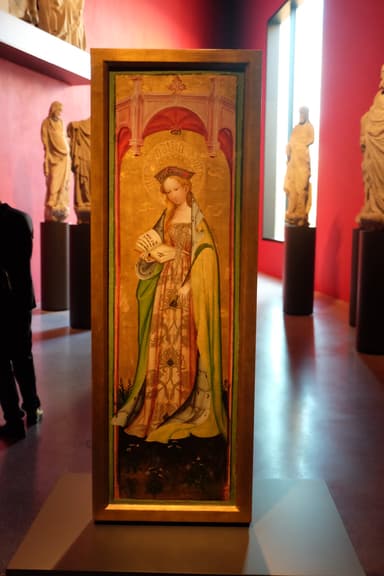
Saint Odilia, attributed to Conrad von Soest
Brief life
Odilia is the patron saint of Alsace and the founder of the great monastic complex on Mount Sainte-Odile — the Hohenburg — which remains one of the oldest and most continuously venerated pilgrimage sites in the Alsatian countryside. She died around 720, and the early biography attributed to her is largely legendary in its specific details, but the foundation she made at Hohenburg is a historical fact of the first order, documented continuously from the early eighth century.
The legend gives her as the daughter of the Frankish duke Adalric, born blind, who ordered her exposed or killed because of her disability and the shame he attached to it. She was spirited away by a servant and raised in a Burgundian convent, where at her baptism by Bishop Erhard of Regensburg she received her sight — the name Odilia, from the German Ottilia, being associated with the restoration of vision. When she eventually returned to her father and was reconciled to him, he gave her the mount now called after her and she founded the monastic community that became the heart of Alsatian Christianity.
The legendary elements require careful handling. The birth-blindness and miraculous sight at baptism is a narrative type that appears in other early medieval hagiography; the cruel father who becomes a benefactor is equally conventional. The conventional elements need not preclude a historical person whose life was simplified and structured by the tradition into familiar hagiographical patterns, even if that historical figure cannot be recovered from beneath them.
What is certain is the monastery at Hohenburg, its early eighth-century foundation, and the continuous pilgrimage that made it the principal sanctuary of Alsace throughout the medieval period. The healing of eye diseases that became her specific intercessory patronage follows naturally from the restoration of sight at her baptism. She is still invoked by the blind and by those with diseases of the eye.
Next step
St. Odilia Novena
A novena connected to this saint is in the library.
Keep reading
Nearby saint lives
Move through the calendar without leaving the saint library. These nearby feast-day lives help keep the reading trail connected.
Pray with this saint
Carry this saint into prayer
If this life stirred a particular need, keep going with the closest prayer links in the library.