Lives Of The Saints
February 25
St. Walburga
Quick answer
At a glance
- What it is
- Walburga was one of the English nuns who went to Germany with Boniface, governed the double monastery of Heidenheim after her brother's death, and became.
- Feast
- February 25
- Source
- Butler's Lives of the Saints, Volume I (January-February-March), February 25, St Walburga, Virgin and Abbess, Christian Classics 1990, pp. 421–423. Read the source standards.
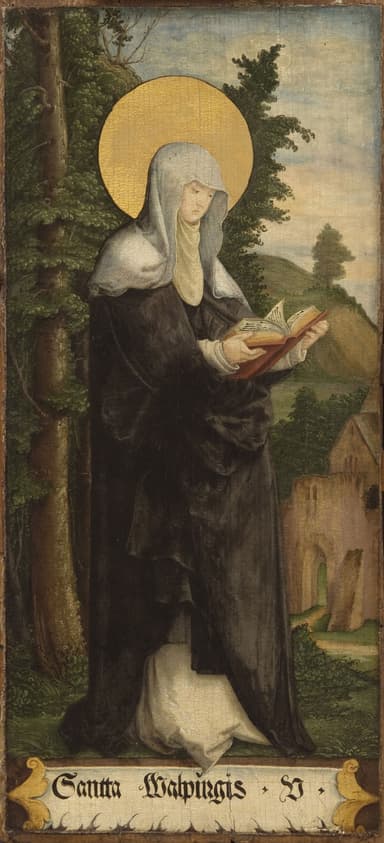
Saint Walpurgis, Master of Messkirch
Brief life
Walburga is one of the English saints who crossed to Germany with St. Boniface and his companions in the eighth-century mission to the Germanic peoples, and her story is bound up with the larger enterprise of those remarkable monastics who carried Irish and Anglo-Saxon Christianity into what became the Carolingian heartland. She was born in Devonshire around 710, niece of Boniface and sister of Willibald and Winnebald, and was educated at the monastery of Wimborne in Dorset before Boniface summoned her to Germany around 748.
She joined the double monastery at Heidenheim which her brother Winnebald had founded, and on Winnebald's death in 761 she became abbess of both the men's and women's houses — an authority that surprised contemporaries less than it might surprise a later age, because the double monastery under an abbess had recent English precedents in figures like Hild of Whitby. She governed Heidenheim until her own death in 779, presiding over a community that combined the English tradition of learning and manuscript culture with the practical demands of mission Christianity.
What secured her subsequent veneration was the translation of her relics in 870 to Eichstätt, which fell on the first of May — a date whose coincidence with the Germanic spring festivals gave rise to the term Walpurgisnacht, the night before her feast, which popular tradition in Germany filled with the kind of supernatural fears the Church was perpetually trying to displace. There is an instructive irony here: a sober English abbess became the patron saint of a night associated in folklore with witches and demons precisely because her feast displaced and renamed one of the great pagan calendrical moments.
The healing oil said to flow from her relics — the oleum Walburgense — is documented from the ninth century and gave her a specific intercessory reputation. She was invoked against plague, famine, and especially rabies. The oil is reported without adjudicating its miraculous character; the devotion it sustains is genuine.
Next step
Novena to St. Walburga
A novena connected to this saint is in the library.
Keep reading
Nearby saint lives
Move through the calendar without leaving the saint library. These nearby feast-day lives help keep the reading trail connected.
Pray with this saint
Carry this saint into prayer
If this life stirred a particular need, keep going with the closest prayer links in the library.