Lives Of The Saints
November 20
St. Felix of Valois
Quick answer
At a glance
- What it is
- Felix of Valois was the forest hermit who encountered John of Matha and together with him founded the Trinitarians.
- Feast
- November 20
- Source
- Butler's Lives of the Saints, Volume IV (October-November-December), November 20, St Felix of Valois, Confessor, Christian Classics 1990, pp. 380–382. Read the source standards.
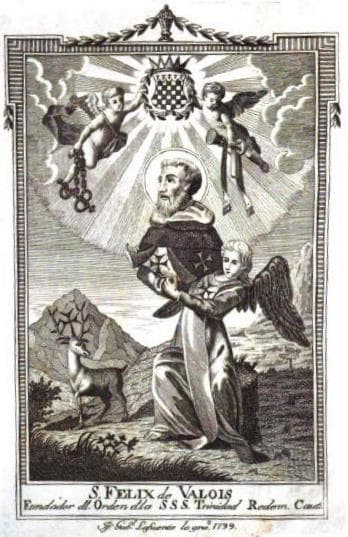
Saint Félix de Valois, devotional portrait
Brief life
Felix of Valois is the co-founder, with John of Matha, of the Trinitarian Order — the Order of the Holy Trinity for the Redemption of Captives — and he appears alongside his co-founder, whose entry carries the more substantial biographical weight because John of Matha's life is better documented. Felix's biography is sparse, and it is worth acknowledging this directly rather than papering over it.
He was, by the tradition, a hermit living at the source of the Cernon River in the forest of Cerfroid in the Valois region of France when John of Matha encountered him around 1193. The two men together developed the idea of an order dedicated to the ransom of Christian captives and went to Rome to secure papal approval for it. Innocent III approved the new order in 1198, and the rule composed under the combined influence of both men — though the details of who contributed what cannot now be determined — established the distinctive Trinitarian charism: a third of all revenues to be devoted to the ransom of captives, with members available to travel to Muslim territories and negotiate releases.
Felix died at Cerfroid in 1212, apparently without leaving the community he had helped to found. His age at death is uncertain; the tradition makes him old, having been a hermit for many years before the founding encounter with John of Matha. He was beatified in 1262 and formally canonized in 1694.
His significance is institutional rather than biographical. The order he co-founded became one of the most active redemptive institutions of the medieval church, sending missions across generations to North Africa and Spain, ransoming thousands of captives. The hermit who came out of the forest to join a project for freeing prisoners represents one of the stranger transitions in the history of the religious life, and it resists resolution into something tidier than it was.
Next step
Browse the novena library
Browse the broader library if you want to move from reading into prayer.
Keep reading
Nearby saint lives
Move through the calendar without leaving the saint library. These nearby feast-day lives help keep the reading trail connected.
Pray with this saint
Carry this saint into prayer
If this life stirred a particular need, keep going with the closest prayer links in the library.