Lives Of The Saints
February 22
St. Margaret of Cortona
Quick answer
At a glance
- What it is
- Margaret of Cortona began her life as a nobleman's mistress and came to holiness through an abrupt conversion after his murder.
- Feast
- February 22
- Source
- Butler's Lives of the Saints, Volume I (January-February-March), February 22, St Margaret of Cortona, Penitent, Christian Classics 1990, pp. 398–402. Read the source standards.
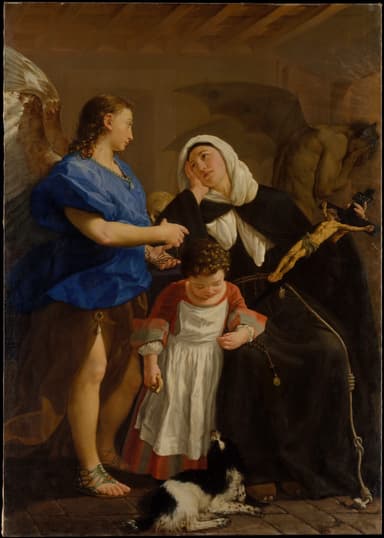
Saint Margaret of Cortona, devotional painting
Brief life
Margaret of Cortona deserves to be presented with the full weight of her story — beginning not with her conversion but with the years that preceded it. She was born in 1247 near Laviano in Tuscany and for nine years was the mistress of a nobleman of Montepulciano named Arsenio, who kept her well and whom she loved. She had a son by him. Arsenio was murdered, and his dog, coming back without him, led Margaret to the place in the forest where his body was hidden. Something broke in her at that moment which was never repaired — or rather, which was repaired only in a different direction entirely. She tried to return to her father, who would not receive her back. She went to the Franciscan friars at Cortona and placed herself under their guidance.
The conversion that followed was thorough and violent. The penitential life is the central fact of her biography: the hair shirt, the severe fasting, the self-mortification that her confessor Fra Giunta repeatedly found excessive and tried to moderate with limited success. She quarreled with him about this, and the quarrel is presented honestly: she believed her past required an answering severity; he believed her present health required restraint; neither was entirely wrong. Her mystical life included interior locutions and experiences that are treated with appropriate caution, neither dismissed nor pressed beyond what the evidence supports.
What is most substantial in her later life is the concrete institutional work. She founded a hospital at Cortona for the poor and the sick, the Ospedale di Santa Maria della Misericordia, which served the city for generations. She established a confraternity of Our Lady of Mercy to support it. These are the marks of a woman not consumed by her own spiritual drama but genuinely turned outward toward others. She died in 1297 and was canonized in 1728. The long interval before canonization reflects the complexity of evaluating her mystical claims; the holiness, once confirmed, was not in doubt.
Next step
St. Margaret of Cortona Novena
A novena connected to this saint is in the library.
Keep reading
Nearby saint lives
Move through the calendar without leaving the saint library. These nearby feast-day lives help keep the reading trail connected.
Pray with this saint
Carry this saint into prayer
If this life stirred a particular need, keep going with the closest prayer links in the library.