Lives Of The Saints
October 21
St. Ursula and Companions
Quick answer
At a glance
- What it is
- St. Ursula and Companions: The legend of Ursula and her companions grew into a monument of medieval devotion from a very sparse historical foundation.
- Feast
- October 21
- Source
- Butler's Lives of the Saints, Volume IV (October-November-December), October 21, St Ursula and her Companions, Virgins and Martyrs, Christian Classics 1990, pp. 160–163. Read the source standards.
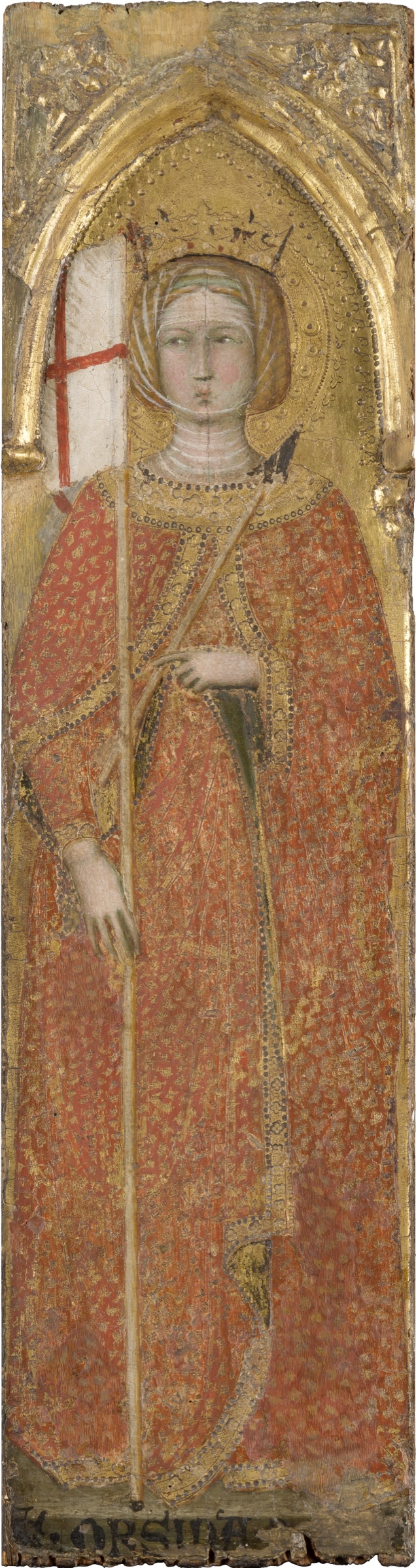
Saint Ursula, Francesco Vanni
Brief life
Ursula and her companions pose in acute form the problem of a legend grown so immense — eleven thousand virgin martyrs at Cologne — that the disproportion between it and what can actually be known must be addressed directly. The historical question demands both respect for the cult and rigour about its historical foundations.
The historical kernel appears to be a group of virgins martyred at Cologne, probably in the fourth century, whose names and numbers the earliest inscriptions do not reliably preserve. The most important early evidence is an inscription found at Cologne naming a certain Clematius who restored or rebuilt a basilica over the site of a martyrdom — a basilica that had fallen into ruin — but giving no names, no leader, and no number for the martyred group. From this very sparse beginning, the legend expanded across the medieval centuries into the elaborate account of Ursula the British princess, her ten noble companions each with a thousand virgins in their trains, the betrothal to the pagan Ætherius, the sea voyage to the continent, the pilgrimage to Rome, the return through Cologne, the encounter with the Hunnic army that demanded submission or massacre.
The eleven thousand figure is traceable to a probable misreading of an early inscription: the abbreviation XI M V, intended to read Undecim Martyres Virgines — eleven virgin martyrs — was read instead as Undecim Millia Virginum, eleven thousand virgins. The error once made spread rapidly through a devotional tradition that had no interest in correcting it.
The elaborate biography cannot be accepted as history. The historical core that stands is this: women were martyred at Cologne and were venerated from a very early date; the bones found in the cemetery outside the city walls gave the cult its physical reality. What the cult expressed — the consecrated virgin who would die rather than deny her vow and her Lord — was real and remains real, even when the biography behind it proves to be medieval imagination working on an ancient but imprecise memory.
Next step
Novena to St. Ursula
A novena connected to this saint is in the library.
Keep reading
Nearby saint lives
Move through the calendar without leaving the saint library. These nearby feast-day lives help keep the reading trail connected.
Pray with this saint
Carry this saint into prayer
If this life stirred a particular need, keep going with the closest prayer links in the library.