Lives Of The Saints
November 3
St. Winifred
Quick answer
At a glance
- What it is
- Winifred of Holywell was the Welsh patron whose beheading legend is hagiographical in its specific elements.
- Feast
- November 3
- Source
- Butler's Lives of the Saints, Volume IV (October-November-December), November 3, St Winifred, Virgin and Martyr, Christian Classics 1990, pp. 242–244. Read the source standards.
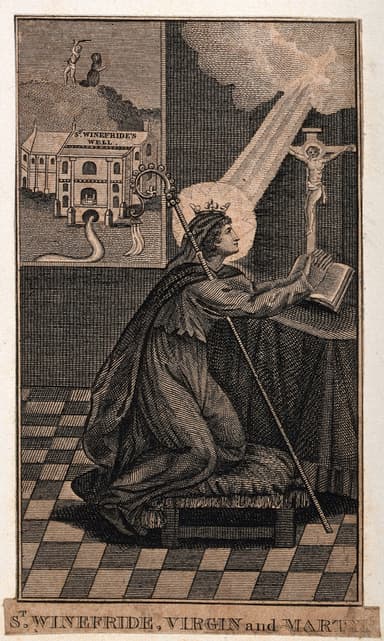
Saint Winifred, devotional engraving
Brief life
Winifred — Gwenfrewy in Welsh — is the patron of north Wales and the centre of the most continuously active pilgrimage site in Britain: the holy well at Holywell in Flintshire that has drawn pilgrims without interruption from the seventh century to the present. The biography that gives the well its origin belongs firmly to the category of hagiographical legend, but the well itself and the unbroken continuity of devotion to it are historical facts of the first order.
The legend: Winifred was the niece of St. Beuno, a seventh-century Welsh nobleman's daughter who consecrated her virginity to God under her uncle's guidance. A local chieftain named Caradoc, refused her hand, beheaded her on the spot. Where her head fell, a spring burst from the earth. St. Beuno restored her to life by replacing the head, and the mark where the head had been separated remained visible as a white line around her neck for the rest of her days. She later entered the religious life, eventually becoming abbess of Gwytherin in Denbighshire, where she died.
The narrative is legendary in its specific elements, but the historical substrate is real. A holy woman named Winifred was venerated in the seventh century in north Wales; a spring was associated with her from a very early date; the spring became the centre of pilgrimage. What the legend expresses — the violent attempt to seize what could not be given, the death at the moment of refusal, the emergence of healing from the place of violence — is the symbolic vocabulary of virgin martyr hagiography applied to a real local holy woman.
The continuing pilgrimage at Holywell — which included among its visitors Henry V on pilgrimage after Agincourt, and Richard I's wife Berengaria, and the Welsh poet Dafydd ap Gwilym — is the most substantial evidence of a genuine sanctity whose specific historical details have been shaped, but not invented, by the tradition.
Next step
Novena to Saint Winifred
A novena connected to this saint is in the library.
Keep reading
Nearby saint lives
Move through the calendar without leaving the saint library. These nearby feast-day lives help keep the reading trail connected.
Pray with this saint
Carry this saint into prayer
If this life stirred a particular need, keep going with the closest prayer links in the library.