Prayerful reading from traditional Catholic sources
Catholic Meditations
Consider a truth of the Faith or a mystery in the life of Our Lord. Choose a meditation below, read slowly, and pause to pray.
How to meditate
A brief summary of St. Francis de Sales’s method, not a quotation or a new meditation.
- Remember God’s presence. Recollect yourself before Him with reverence.
- Ask for His help. Humbly ask for the grace to pray and serve Him.
- Consider the subject. For a Gospel scene, picture the mystery as the guide directs. Not every subject calls for an image.
- Read and pause. Stay with a consideration while it helps you love God. You need not hurry through every point.
- Respond and resolve. Turn your thoughts into love, sorrow for sin, gratitude, or petition. Choose a definite action to put into practice.
- Conclude in prayer. Thank God, offer Him your resolutions through Our Lord, and ask for help to keep them. Pray for others and finish with the Our Father.
- Carry a thought with you. Keep one fruitful thought for the day, the saint’s “spiritual bouquet.”
If prayer feels dry, do not be discouraged. St. Francis recommends vocal prayer or attentive spiritual reading, and calmly persevering before God.
How to meditate: source
St. Francis de Sales, Introduction to the Devout Life (first published 1609), Part II, chapters II to VII and IX. The steps above are an editorial summary; the meditations below retain their source wording.
Read the saint’s methodRead his counsel on dryness in prayer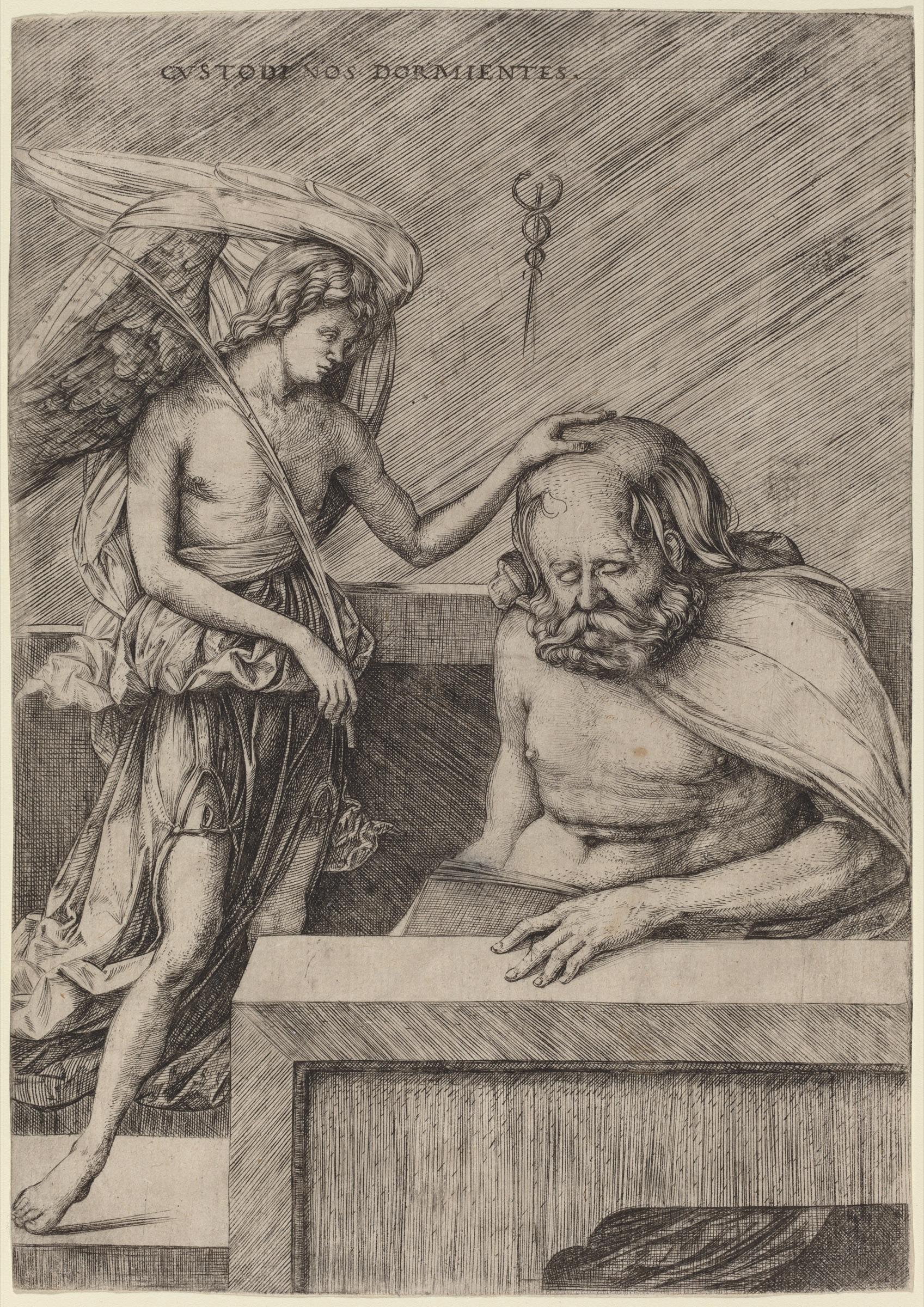
From Bishop Richard Challoner
On Our Guardian Angels
Challoner’s meditation for October 2, with his three considerations and concluding resolution.
Consider God’s care for us through His angels, and the reverence, confidence, and gratitude we owe for their guardianship.Read more: On Our Guardian Angels Read less: On Our Guardian Angels
Consider first, that this day is set aside by the Church to glorify God, and to give him thanks, through Jesus Christ his Son, for that inestimable benefit of his divine goodness, by which he has appointed his heavenly spirits to attend on us, and to guard us, during this pilgrimage of our mortality, till they bring us home to himself, and to a happy eternity. Give ear to the word of God himself on this subject, Ps. xc.: “There shall no evil come to thee: nor shall the scourge come near thy dwelling. For he hath given his Angels charge over thee, to keep thee in all thy ways: in their hands they shall bear thee up, lest thou dash thy foot against a stone,” St. Mat. xviii. “Take heed that you despise not one of these little ones; for I say to you, that their angels in heaven always see the face of thy Father who is in heaven,” Heb. i. “Are they not all ministering spirits, sent to minister for them, who shall receive the inheritance of salvation,” Ex. xxiii. “Behold I will send my Angel, who shall go before thee, and keep thee in thy journey, and bring thee into that place that I have prepared. Take notice of him, and hear his voice, &c.” Yes, Christians, let us attend to these our heavenly guardians, who are ever inviting us to the love and service of our God, and inspiring us with pious thoughts to this effect; and with their assistance we shall defeat all our enemies, and make our way safely to our eternal country, in spite of all the opposition of hell, according to that of Exod. xxiii. 22: “If thou wilt hear his voice and do all that I speak, I will be an enemy to thine enemies, and I will afflict them that afflict thee; and the Angel shall go before thee, and shall bring thee in to the promised land, the figure of the heavenly Canaan.”
Consider 2dly, with St. Bernard, (writing on those words, he hath given his angels charge over thee,) the wonders of God’s bounty and love for us, expressed in this commission given to his angels. “For who is it that has given this charge? To whom? Of whom? And what is the charge he has given? O let us think well of this grand commission: let us lay it up diligently in our memory. Who has given this charge? Whose angels are they? Whose will do they obey? He has given his Angels charge over thee, to keep thee in all thy ways; nor do they stick to bear thee up in their hands. ’Tis then the sovereign Majesty has given a charge to Angels, yea, to his own Angels he has given a charge; to these sublime spirits, so happy, so nearly adhering to himself, and to his own domestics, he has given a charge of thee. And who art thou? What is man that thou art mindful of him? or the Son of man, that thou makest any account of him? As if man were not rottenness, and the son of man a worm. And what is this commission he has given his Angels concerning thee? Even to be thy guardians. O wonderful condescension! O truly great affection of charity!”
Consider 3dly, with the same Saint, “What reverence, what devotion, what confidence, this saying, that God has given his Angels a charge over thee to keep thee in all thy ways, ought to inspire thee with a reverence for their presence, a devotion for their benevolence, a confidence for their guardianship. Walk cautiously, as having the Angels always in thy company; who according to their commission, are with thee in all thy ways. In every place, in every corner, have respect to thy angel. Never dare to do that in his presence, which thou wouldst not dare to do before me. In God then my brethren, let us affectionately love his angels, that are to be one day joint heirs with us, but in the mean time are appointed by our Father, and set over us, as tutors and governors. What have we to fear under such guardians as these; they can neither be overcome nor deceived, who keep us in all our ways; much less can they deceive us. They are faithful, they are wise, they are powerful; what are we afraid of; let us only follow them, let us stick close to them, and we shall abide under the protection of the God of heaven.”
Conclude to follow in practice these prescriptions of this great Saint; and, as he adds in the same discourse, when at any time we perceive a temptation arising, or we are threatened with any grievous tribulation, let us call upon these our heavenly keepers, our guides, our helpers, in due time, in distress; and we shall experience a powerful assistance from them superior to all the powers of earth and hell.
Scripture: Psalm 90:10-12; St. Matthew 18:10; Hebrews 1:14; Exodus 23:20-23.
The historical text prints “thy Father” in its quotation of Matthew 18:10. That wording is retained here; the linked Douay-Rheims Bible reads “my Father.”
Guardian Angels: text and artwork
Source: Richard Challoner, Meditations for Every Day in the Year, “On our Guardian Angels,” October 2, Dublin: James Duffy, 1859, printed pages 409 to 411. This is a transcription checked against the scanned pages. Spacing and punctuation are normalized; the wording is Challoner’s.
View the original meditation in the 1859 scanArtwork: Jacopo de’ Barbari, Custodi Nos Dormientes (The Guardian Angel), about 1509. National Gallery of Art. CC0 public-domain dedication.
Artwork record and credit,_c._1509,_NGA_4160.jpg)
St. Ignatius of Loyola · Spiritual Exercises
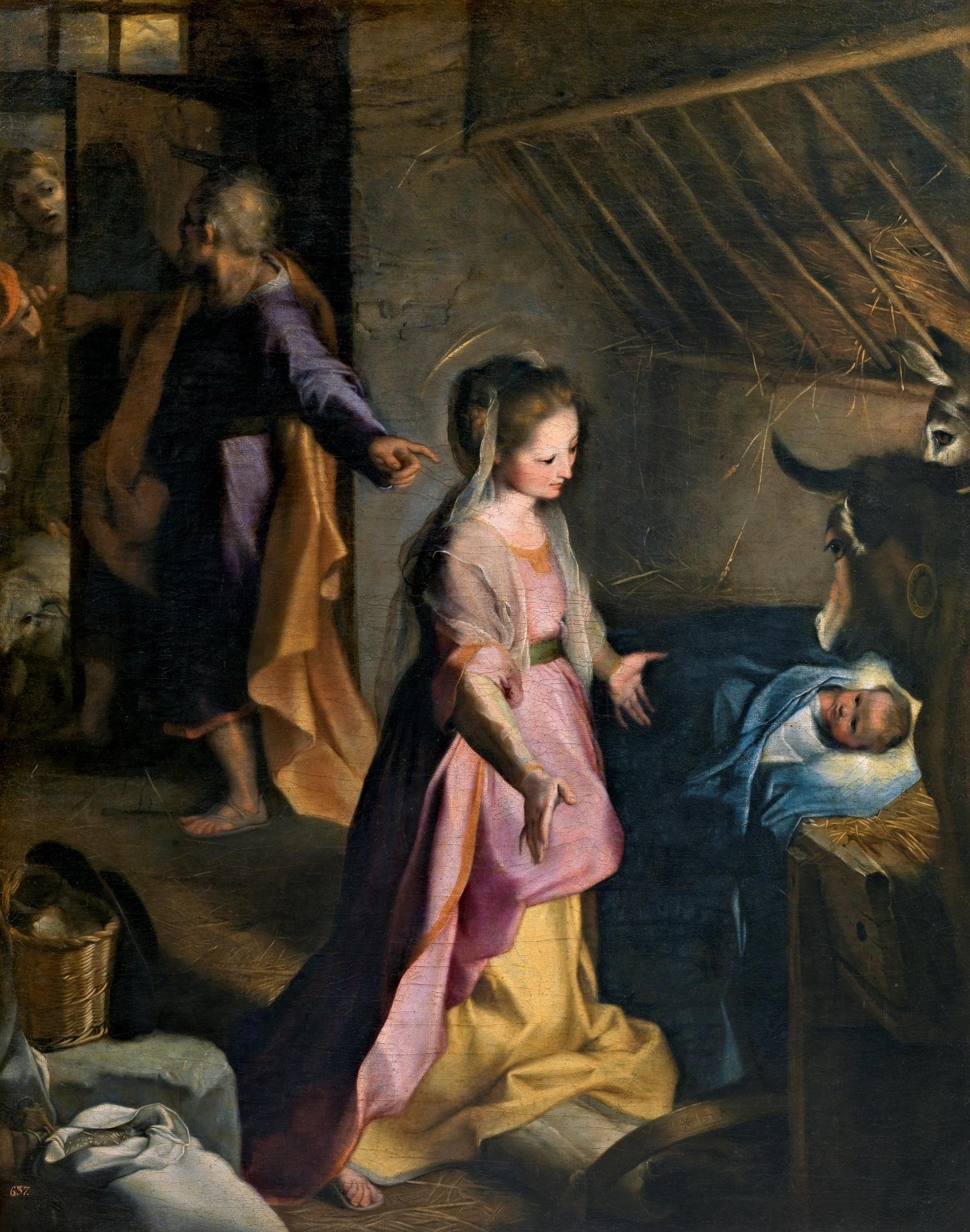
The Nativity
A contemplation of Our Lord’s birth from the Spiritual Exercises.
Contemplate the Holy Family at Bethlehem, the poverty of Our Lord’s birth, and His love for us. St. Ignatius invites you to consider the persons, their words, and their actions.Read more: The Nativity Read less: The Nativity
Prayer. The usual Preparatory Prayer.
First Prelude. The first Prelude is the narrative and it will be here how Our Lady went forth from Nazareth, about nine months with child, as can be piously meditated, seated on an ass, and accompanied by Joseph and a maid, taking an ox, to go to Bethlehem to pay the tribute which Caesar imposed on all those lands.
Second Prelude. The second, a composition, seeing the place. It will be here to see with the sight of the imagination the road from Nazareth to Bethlehem; considering the length and the breadth, and whether such road is level or through valleys or over hills; likewise looking at the place or cave of the Nativity, how large, how small, how low, how high, and how it was prepared.
Third Prelude. The third will be the same, and in the same form, as in the preceding Contemplation.
First Point. The first Point is to see the persons; that is, to see Our Lady and Joseph and the maid, and, after His Birth, the Child Jesus, I making myself a poor creature and a wretch of an unworthy slave, looking at them and serving them in their needs, with all possible respect and reverence, as if I found myself present; and then to reflect on myself in order to draw some profit.
Second Point. The second, to look, mark and contemplate what they are saying, and, reflecting on myself, to draw some profit.
Third Point. The third, to look and consider what they are doing, as going a journey and laboring, that the Lord may be born in the greatest poverty; and as a termination of so many labors, of hunger, of thirst, of heat and of cold, of injuries and affronts, that He may die on the Cross; and all this for me: then reflecting, to draw some spiritual profit.
Colloquy. I will finish with a Colloquy as in the preceding Contemplation, and with an Our Father.
Scripture: St. Luke 2:1-20. Read the Douay-Rheims Gospel.
This passage refers to preparations in preceding exercises. Consult the complete source for those instructions. The maid, ox, and other imagined details are part of the contemplation, not details asserted by St. Luke. Mullan advises making the Exercises under a competent guide; this reading is not a complete retreat.
The Nativity: text and artwork
Source: St. Ignatius of Loyola, Spiritual Exercises, Second Week, First Day, Second Contemplation, “The Nativity,” sections 110 to 117. English translation by Elder Mullan, S.J. (1914). The wording follows that translation; punctuation is lightly normalized and the translator’s manuscript notes are omitted.
Mullan’s preface says the Exercises are meant to be pondered under the direction of a competent guide. This page presents the sourced Nativity passage, not a complete retreat.
Read the complete Spiritual Exercises and source notesArtwork: Federico Barocci, The Nativity, Museo del Prado. Public domain.
Artwork record and credit.jpg)
St. Francis de Sales · Introduction to the Devout Life
Begin with the foundations
The first six meditations in the saint’s introductory series. Each includes preparation, considerations, a response to God, and a conclusion. The short previews are editorial summaries; open each reading for the historical text.
St. Francis de Sales
The Creation
Consider the gift of your existence, give thanks to your Creator, and offer Him the life He has given you.Read more: The Creation Read less: The Creation
Preparation
1. Place yourself in the presence of God.
2. Beseech Him to inspire you.
Considerations
1. Consider that not many years ago you were not yet in the world, and that your being was a mere nothing. Where were we, O my soul, at that time? The world had then lasted so many ages, and yet we existed not.
2. God has formed you out of nothing, to make you what you are: purely of his own goodness, having no need whatsoever of you.
3. Consider the being that God has given you, for it is the highest in the visible world, capable of eternal life, and of being perfectly united to his Divine Majesty.
Affections and Resolutions
1. Humble yourself exceedingly in the presence of God, saying in your heart with the Psalmist: O Lord, I am in thy sight as a mere nothing, and how hast Thou thought of me to create me? Alas! my soul, thou wert lost in that ancient nothing, and hadst yet been there had not God drawn thee from thence: and what couldst thou have done remaining there?
2. Give thanks to God: O my great and good Creator, how am I indebted to Thee, since Thou hast vouchsafed to make me out of nothing, and by thy great mercy to make me what I am. What can I do to bless thy holy name as I ought, and to render due thanks to thy inestimable goodness?
3. Confound yourself: But, alas! my Creator, instead of uniting myself to Thee by love and service, I have become rebellious by my inordinate affections, wandering and straying from Thee, to unite myself to sin: valuing thy goodness no more than if Thou hadst not been my Creator.
4. Prostrate yourself before God: O my soul, know that the Lord is thy God: it is He that has made thee, and not thou thyself. O God, I am the work of thy hand.
I will not, henceforth, take pleasure in myself, since of myself I am nothing. Why dost thou magnify thyself, O dust and ashes! yea, rather, O mere nothing, why dost thou exalt thyself? To humble myself, therefore, I resolve to do such-and-such things, to suffer such-and-such disgraces. I will change my life, henceforth follow my Creator, and esteem myself honoured with that condition and being which He has given me, employing it entirely in obedience to his will, by such means as shall be taught me, and as I shall learn from my spiritual father.
Conclusion
1. Give thanks to God: Bless thy God, O my soul, and let all my being praise his holy name, for his goodness has drawn thee, and his mercy has created me out of nothing.
2. Offering: O my God, I offer to Thee the being which Thou hast given me; from my heart I dedicate and consecrate it to Thee.
3. Prayer: O God, strengthen me in these affections and resolutions. O holy Virgin, recommend them to the mercy of thy Son, with all for whom I ought to pray, &c. Pater, Ave, Credo.
After your prayer, out of these considerations which you have made, make a little spiritual nosegay to smell all the rest of the day.
The Creation: source
St. Francis de Sales, An Introduction to the Devout Life, Part I, chapter IX, printed pages 17 to 18. Dublin: M. H. Gill and Son, 1885. The title page does not name a translator.
Transcribed against the printed scan. Historical wording is retained, including period expressions; spacing, punctuation, and heading capitalization are normalized. This is not a modernized meditation.
View the original printed pagesSt. Francis de Sales
On the End for Which We Were Created
Reflect on why God made you: to know Him, love Him, and use the gifts He has given you in His service.Read more: On the End for Which We Were Created Read less: On the End for Which We Were Created
Preparation
1. Place yourself before God.
2. Beseech Him to inspire you.
Considerations
1. God has not placed us in this world for any need He has of us, who are altogether unprofitable to Him, but only in order to exercise his goodness in us, by giving us his grace and glory. And to that end He has enriched us with an understanding to know Him, with a memory to be mindful of Him, a will to love Him, an imagination to represent to ourselves his benefits, eyes to behold his wonderful works, a tongue to praise Him, and so of our other faculties.
2. Being created, and put into the world with this intention, all actions contrary to it are to be avoided and rejected; and those which do not conduce to this end should be despised as vain and superfluous.
3. Consider the wretchedness of worldlings who never think of this, but live as though they believed themselves created to no other end but to build houses, plant trees, hoard up riches, and such like follies!
Affections and Resolutions
1. Confound yourself, reproaching your soul with her misery, and for having forgotten these truths: Alas! you shall say, how did I employ my thoughts, O God, when I placed them not upon Thee? What did I remember when I forgot Thee? What did I love, when I loved not Thee? Alas! I ought to have nourished myself upon truth, and I have glutted myself with vanity: slave of the world, I have served that which was created only to serve me.
2. Detest your past life: I renounce you, O vain thoughts and unprofitable fancies. I abhor you, O frivolous and hateful remembrances: O unfaithful and disloyal friendships, impure and wretched slaveries, ungrateful contentments and irksome pleasures, I abhor you.
3. Return to God: And Thou, O my God, my Saviour, Thou shalt be from henceforth the sole object of my thoughts: I will no more apply my mind to such as are displeasing to Thee. My memory shall entertain itself all the days of my life with the greatness of thy clemency, so mercifully exercised on me: Thou shalt be the delight of my heart, and the sweetness of my whole being.
4. Ah! such-and-such vanities and amusements, to which I applied myself; such-and-such unprofitable employments, in which I wasted my days; such-and-such affections which captivated my heart, shall henceforth be objects of horror to me: and to this end I will use such-and-such good remedies.
Conclusion
1. Thank God, who made you for so excellent an end: Thou hast created me, O Lord for thyself, and for the eternal enjoyment of thy incomprehensible glory: Oh, when shall I be worthy of it! When shall I bless Thee as I ought?
2. Offering: I offer Thee, O my dear Creator, all these affections and resolutions, with all my heart and soul.
3. Prayer: I beseech Thee, O God, to accept these my desires and vows, and to give thy holy benediction to my soul to the end that it may accomplish them, through the merits of thy blessed Son’s blood, shed upon the cross for me. Pater, Ave, Credo. [Make here a little spiritual nosegay.]
On the End for Which We Were Created: source
St. Francis de Sales, An Introduction to the Devout Life, Part I, chapter X, printed pages 19 to 20. Dublin: M. H. Gill and Son, 1885. The title page does not name a translator.
Transcribed against the printed scan. Historical wording is retained, including period expressions; spacing, punctuation, and heading capitalization are normalized. This is not a modernized meditation.
View the original printed pagesSt. Francis de Sales
On the Benefits of God
Recall God’s gifts of body, mind, and grace. Let gratitude lead you to prayer and a concrete resolution to serve Him.Read more: On the Benefits of God Read less: On the Benefits of God
Preparation
1. Place yourself in the presence of God.
2. Beseech Him to inspire you.
Considerations
1. Consider the bodily advantages which God has given you: what a perfect body, and what means to maintain it; what health and lawful recreations to entertain it; what friends and assistances. But consider all this with respect to many other persons, much more worthy than yourself, who are destitute of all these blessings; some defective in their bodies, health, and members; others abandoned to the stings of reproaches, contempt, and dishonour; others oppressed with poverty, and God has not suffered you to become so miserable.
2. Consider the gifts of mind: How many are there in the world stupid, frantic, and mad; and why are not you of this number? God has favoured you. How many are there who have been brought up in coarse habits and extreme ignorance? And by God’s providence you have been educated well and honourably.
3. Consider the spiritual graces: You are a child of the Catholic Church. God has taught you to know Him even from your youth. How often has He given you his sacraments? How many inspirations, interior illuminations, and reproaches of conscience for your amendment? How frequently has He pardoned you your faults? How often has He delivered you from the occasions of losing your soul, to which you are exposed? And was there not for years given you leisure and opportunity to advance the good of your soul? Consider in particular how good and gracious God has been to you.
Affections and Considerations
1. Admire the goodness of God: Oh, how good is God to me! Oh, how gracious is He! How rich is thy Heart, O Lord, in mercy, and how liberal in clemency? O my soul, let us publish for ever the many favours He has done us.
2. Repent of your ingratitude: But what am I, O Lord, that Thou art so mindful of me! Ah, how great is my unworthiness! Alas! I have even trampled thy blessings under foot; I have dishonoured thy graces, converting them into abuse and contempt of thy sovereign goodness. I have opposed the depth of my ingratitude to the height of thy grace and favour.
3. Stir yourself up to great thankfulness: Well, then, my heart, be now no longer unfaithful, ungrateful, and disloyal to so great a Benefactor. And how shall not my soul henceforth be wholly subject to God, who has wrought so many wonders and favours in me and for me?
Ah! withdraw, then, your body, Philothea, from such-and-such sensualities, and consecrate it to the service of God, who has done so much for it. Apply your soul to know and acknowledge Him by such exercises as shall be requisite for that purpose. Employ diligently the means which the Church affords you to save yourself and love Almighty God. Yes, O my God, I will pray frequently. I will hear your holy word, and put in practice your inspirations and counsels.
Conclusions
1. Thank God for the knowledge He has now given you of your duty, and for the benefits hitherto received.
2. Offer Him your heart with all your resolutions.
3. Pray Him to enable you to practise them faithfully, through the merits of his Son’s death: implore the intercession of the Blessed Virgin, and of the saints. Pater, Ave, Credo. [Here make a little spiritual nosegay.]
On the Benefits of God: source
St. Francis de Sales, An Introduction to the Devout Life, Part I, chapter XI, printed pages 21 to 23. Dublin: M. H. Gill and Son, 1885. The title page does not name a translator.
Transcribed against the printed scan. Historical wording is retained, including period expressions; spacing, punctuation, and heading capitalization are normalized. This is not a modernized meditation.
View the original printed pagesSt. Francis de Sales
On Sin
Reflect on sin and ingratitude, ask God’s pardon, and resolve to return to Him with confidence in His mercy.Read more: On Sin Read less: On Sin
Preparation
1. Place yourself in the presence of God.
2. Beseech Him to inspire you.
Considerations
1. Call to mind how long it is since you began to sin, and examine to how great an extent, since that beginning sins have been multiplied in your heart. How every day you have increased and multiplied your sins against God, against yourself, and against your neighbour, by word, by deed, by desire.
2. Consider, in particular, the sin of ingratitude towards God, which is a general sin, and extends itself over all the rest, making them infinitely more enormous. Consider, then, how many benefits God has bestowed on you, and how you have abused them, turning them against Him, to dishonour Him. And, in particular, how many inspirations you have made unprofitable. But above all, how many times you have received the sacraments, and where are the fruits of them? What is become of all those precious jewels, with which your dear Spouse adorned you? They have all been buried under your iniquities. With what preparation have you received them? Think on your ingratitude; that God having run so far after you, you have fled from Him to lose yourself.
Affections and Resolutions
Be humiliated at the thought of your misery. O my God, how dare I appear before thine eyes? Alas! I am nothing but corruption, and a mere sink of sin and ingratitude. Is it possible that I have been so disloyal as not to have left any one of my senses, not any one of the powers of my soul, which I have not corrupted, violated, and defiled? And that not so much as one day of my life has passed in which I have not brought forth such bad fruits. Is this the use I should have made of the benefits of my Creator, and the Precious Blood of my Redeemer?
2. Ask pardon, and cast yourself at the feet of your Lord, like a prodigal child, like St. Mary Magdalen, or like the woman taken in adultery, at the feet of Jesus, her Judge. Have mercy, O Lord, on this poor sinner! Alas! O Living Fountain of Compassion, have pity on this wretch.
3. Resolve to live better: No, O Lord, never more, with the help of thy grace, never more will I abandon myself to sin. Alas! I have loved it too much; now I detest it, and embrace Thee, O Father of Mercy. I live and die in Thee.
To expiate my past sins I will accuse myself of them courageously, and will not leave one unbanished from my heart.
I will use all possible endeavours to extirpate all the roots of sin from my heart, and, in particular, such-and-such vices, which chiefly cause me remorse.
To accomplish this, I will constantly embrace the means which shall be recommended to me, and think I have never done enough to repair such grievous offences.
Conclusions
1. Give God thanks for awaiting your amendment to this hour, and bless Him that He has given you such good dispositions.
2. Offer Him your heart, that you may put them in execution.
3. Pray that He may give you grace, strength, &c. Pater, Ave, Credo. [Here make a spiritual nosegay.]
On Sin: source
St. Francis de Sales, An Introduction to the Devout Life, Part I, chapter XII, printed pages 23 to 25. Dublin: M. H. Gill and Son, 1885. The title page does not name a translator.
Transcribed against the printed scan. Historical wording is retained, including period expressions; spacing, punctuation, and heading capitalization are normalized. This is not a modernized meditation.
View the original printed pagesSt. Francis de Sales
On Death
Consider the end of earthly life, entrust yourself to God’s protection, and resolve to prepare for a holy death.Read more: On Death Read less: On Death
Preparation
1. Place yourself in the presence of God.
2. Beseech Him to grant you his grace.
Imagine yourself to be in extremity of sickness, on your death-bed, without any hope of recovery.
Considerations
1. Consider the uncertainty as to the time of your death: O my soul, thou must one day quit this body; but when shall that day be? Shall it be in winter or in summer? Shall it be suddenly or after notice given thee? By sickness or by accident? Shalt thou have leisure to confess thy sins? Shalt thou have the assistance of thy spiritual father? Alas! of all this we know nothing: certain only is it that we shall die, and that always sooner than we expect.
2. Consider, that when the world shall end in regard to you (for this world will be no longer for you) it will perish before your eyes; for then the pleasures, the vanities, the worldly joys and fond affections of our lives will seem to us mere shadows and airy clouds. Ah, wretch! for what toys and trifles have I offended God? You shall then see that for a mere nothing you have forsaken Him. On the contrary, devotion and good works will then seem to you sweet and delightful. Oh, why did I not follow this fair and pleasant path? Then sins, which seemed but little, will appear as huge as mountains, and your devotion very small.
3. Consider the long, languishing farewell your soul must then give this world; she will then take her leave of its riches and vanities, and of all idle company; of pleasures, pastimes, friends, and neighbours; of kindred and children; of husband and wife; in short, of every creature; and, finally, of her very body, which she must leave pale, hideous, and loathsome.
4. Consider with what haste they will carry away that body, to hide it under the earth; which done, the world will think no more of you than you thought of others who died; “God’s peace be with him,” they will say, and that is all. O Death, how void art thou of regard or pity!
5. Consider how the soul, having departed from the body, takes her way to the right or to the left! Alas! whither shall yours go? What way shall it take for eternity? No other than that which it began here in this world.
Affections and Resolutions
1. Pray to God, and cast yourself into his arms: Alas! O my God, receive me under thy protection on that dreadful day; make that hour happy and favourable to me: rather than it should not be so, let all the other days of my life be sad and sorrowful.
2. Despise the world: Seeing that I know not the hour at which I must leave thee, O wretched world, I will no more fix my love upon thee. O my dear friends and relations, pardon me if I love you only in future with a holy friendship, which may last eternally; for why should I unite myself to you in such a way as to be forced to break and dissolve the knot afterwards?
3. I will, then, prepare myself for that hour, and take all requisite precautions to end this journey happily: I will secure the state of my conscience to the utmost of my ability, and take immediate care to repair the defects to which I am subject.
Conclusion
Give thanks to God for all those resolutions which He has given you: offer them to his Divine Majesty. Beseech of Him to give you a happy death, by the merits of his dearly-beloved Son. Implore the assistance of the Blessed Virgin, and of the saints. Pater, Ave, Credo. [Here make a spiritual nosegay.]
On Death: source
St. Francis de Sales, An Introduction to the Devout Life, Part I, chapter XIII, printed pages 25 to 27. Dublin: M. H. Gill and Son, 1885. The title page does not name a translator.
Transcribed against the printed scan. Historical wording is retained, including period expressions; spacing, punctuation, and heading capitalization are normalized. This is not a modernized meditation.
View the original printed pagesSt. Francis de Sales
On Judgment
Consider the Last Judgment, Christ’s justice and mercy, and the invitation to turn to Him while there is time.Read more: On Judgment Read less: On Judgment
Preparation
1. Place yourself before God.
2. Beseech Him to inspire you.
Considerations
1. After the time that God prescribed for the continuance of this world, after the many signs and horrible presages, which will cause men to faint away with fear and anguish, a deluge of fire shall burn and reduce to ashes everything upon the face of the earth. Nothing which we see there shall be spared.
2. After these flames and thunderbolts, all men shall arise, and at the sound of the trumpet of the Archangel they shall appear in the Valley of Josaphat; but, alas! in what different conditions! for the good shall rise with glorified and resplendent bodies, the bad with bodies most frightful and horrid.
3. Consider the majesty with which the Sovereign Judge will appear, environed with all his angels and saints; his cross, shining much brighter than the sun, shall be carried before Him as a sign of mercy to the good, and of justice to the wicked.
4. This Sovereign Judge, by his dreadful command, which shall be instantly obeyed, will separate the good from the bad, placing the one at his right hand, and the other at his left. Oh, everlasting separation! after this they shall never meet again.
5. This separation being made, and the books of consciences opened, all men shall see clearly the malice of the wicked, and their contempt of God; and on the other side, the penances of the good, and the effects of God’s grace which they have received. Nothing shall lie hid. O God! what a confusion will this be to the reprobate, and what consolation to the saved.
6. Consider the last sentence pronounced against the wicked: “Go, ye accursed, into everlasting fire, prepared for the devil and his angels.” Ponder well on these mighty words. “Go!” saith He, a word of eternal banishment against those miserable wretches, excluding them eternally from his glorious presence. He calls them accursed. O my soul! how dreadful a malediction; a general curse, including all manner of woes; an irrevocable curse, comprehending all times and all eternity. He adds, “into everlasting fire.” Behold, O my soul, this miserable eternity. O eternal eternity of pains, how dreadful art thou!
7. Consider the contrary sentence on the good. “Come!” saith the Judge. O sweet word of salvation, by which God draws us to Himself, and receives us into the arms of his goodness. “Blessed of my Father!” O dear blessing, which comprehends all happiness! “Possess the kingdom which is prepared for you from the beginning of the world.” O God, what an excess of bounty! for this kingdom shall never have an end.
Affections and Resolutions
1. Tremble, O my soul, at the remembrance of these things. O my God, what security shall there be for me on that day, when even the pillars of heaven shall tremble for fear?
2. Detest your sins, which alone can condemn you on that dreadful day.
3. Ah, wretched heart! resolve to amend. O Lord, I will judge myself now, that I may not be judged then. I will examine my conscience, and condemn myself. I will accuse and chastise myself, so that the eternal Judge may not condemn me on that dreadful day. I will therefore confess, and accept of all necessary advice, &c.
Conclusions
1. Thank God, who has given you means to provide for that day, and time to do penance.
2. Offer Him your heart, that He may make good fruits grow from it.
3. Pray of Him to give you his grace.
Pater, Ave, Credo. [Here make a spiritual nosegay.]
On Judgment: source
St. Francis de Sales, An Introduction to the Devout Life, Part I, chapter XIV, printed pages 27 to 29. Dublin: M. H. Gill and Son, 1885. The title page does not name a translator.
Transcribed against the printed scan. Historical wording is retained, including period expressions; spacing, punctuation, and heading capitalization are normalized. This is not a modernized meditation.
View the original printed pagesDom Lorenzo Scupoli · The Spiritual Combat
Of Confidence in God
Spiritual reading for reflection. The preview is an editorial summary; the expanded reading is the complete historical chapter.
Consider how humility and trust in God sustain the struggle for virtue. Scupoli offers four means of growing in confidence in God.Read more: Of Confidence in God Read less: Of Confidence in God
Although a diffidence of ourselves be absolutely necessary in the Spiritual Combat, as I have just now shewn, nevertheless, if this is all we have to trust to, we shall soon be put to flight, plundered and subdued by the enemy. To it therefore we must join a firm confidence in God the author of all good, and from whom alone the victory must be expected. For if it be certain that of ourselves we are nothing, dangerous and continual misfortunes will attend us; and reason will suggest a diffidence of our own strength: but if we are fully convinced of our weakness, we shall gain through the assistance of God, very signal advantages over our enemies, nothing being of greater efficacy for obtaining the assistance of Heaven, than placing a noble confidence in God. We have four means of acquiring this excellent virtue.
The first is to ask it with great humility.
The second is, to contemplate with a lively faith, the immense power and infinite wisdom of that Supreme Being, to whom nothing is difficult, whose goodness knows no limits, whose love for those who serve him, is ever ready to furnish them with whatever is requisite for their spiritual life, and gaining a complete victory over themselves.
All that he demands of them is to have recourse to him with an entire confidence. And can any thing be more reasonable? Is it possible that the amiable Shepherd (Luke xv.) who for upwards of thirty-three years sought after the lost sheep through rough and thorny ways, with so much pain that it cost him the last drop of his sacred blood; is it possible I say, that so good a Shepherd, seeing at last his strayed sheep returning to him with a design of being guided for the future by him alone, and with a sincere, though yet perhaps but weak intention to obey him, he should not look upon it with pity, listen to its cries, nor bear it upon his shoulders to the fold? doubtless he is greatly pleased to see it united again to the flock, and invites the Angels to rejoice with him on the occasion.
For if he searches so diligently after the drachm in the Gospel, by which the sinner is figured, if he leave nothing untouched to find it, can he reject those, who, like sheep longing to behold their Shepherd, return towards the fold? Can it be imagined that the Spouse of our souls, who ardently seeks to take possession of our hearts; whose greatest delight is to communicate himself to us, and heap continual blessings on us; what likelihood is there, but that finding the door open, and hearing us beg to be honoured with his presence, he will vouchsafe to grant our request?
The third means of acquiring this salutary confidence, is frequently to call to mind what we are assured of in the holy Scriptures, those oracles of truth, in a thousand different places, that no one who puts his trust in God shall be confounded.
The fourth means of acquiring both a diffidence of ourselves and confidence in God, is that when we have any good action to perform, or some failing to encounter, before we enter upon it, we cast our eyes upon our own weakness on one side, and on the other contemplate the infinite power, wisdom, and goodness of God, and that balancing what we fear from ourselves, with what we hope from God, we courageously undergo the greatest difficulties and severest trials. With these arms joined to prayer, as we shall see hereafter, we shall be enabled to execute the greatest designs, and gain complete victories.
But if we neglect this method, though we may flatter ourselves we are actuated by a principle of confidence in God, we shall generally be deceived; because presumption is so very natural to man, that it even insinuates itself imperceptibly into the confidence he imagines he has in God, and the diffidence he fancies he has of himself. Consequently in order to banish entirely all presumption, and to sanctify every action with the two virtues opposite to this vice, the consideration of his own weakness must necessarily precede that of the divine Power, and both of them be previous to all undertakings.
Of Confidence in God: source
Dom Lorenzo Scupoli, The Spiritual Combat, chapter III, “Of Confidence in God,” printed pages 17 to 21. Philadelphia: printed for Bernard Dornin at the Catholic Bookstore, 1817. The title page does not name a translator.
Checked against the original printed pages. Historical wording is retained; spacing, capitalization, and punctuation are normalized. This is a spiritual instruction, not a newly composed meditation.
View the original printed pagesAbout these meditations
What is Catholic mental prayer?
In the method of St. Francis de Sales summarized above, you consider a truth of the Faith, respond to God in prayer, and make a particular resolution. Reading provides matter for prayer; the aim is not simply to finish a passage.
Are these original historical texts?
The readings come from identified editions published in 1817, 1859, 1885, and 1914. Source buttons give the book, edition, and chapter or pages. Previews and reading help are editorial and are kept separate from the historical wording.
Do I need to follow a daily sequence?
No. The homepage offers a daily selection, while every reading remains available here. The six meditations by St. Francis de Sales are presented in their original sequence if you wish to follow them in order.
Continue in prayer
More traditional meditations
Meditate on the mysteries of the Rosary
Keep the principal events in the lives of Our Lord and Our Lady in mind while praying the decades.
Open meditationPray the Stations of the Cross
Follow Our Lord from His condemnation to the tomb with a meditation at each station.
Open meditationMeditate on the Seven Sorrows of Our Lady
Pray the traditional chaplet with its seven source-based meditations.
Open meditation