‹ Rosaries & chapletsA Novena Regina prayer companion

The Rosary of the Seven Dolors

The Seven Sorrows
of Our Lady

Remain near her Son.

Seven sorrows of the Blessed Virgin Mary. A traditional prayer that brings us to the life and Passion of Jesus with His Mother.

Traditional prayers · The New Raccolta, 1903

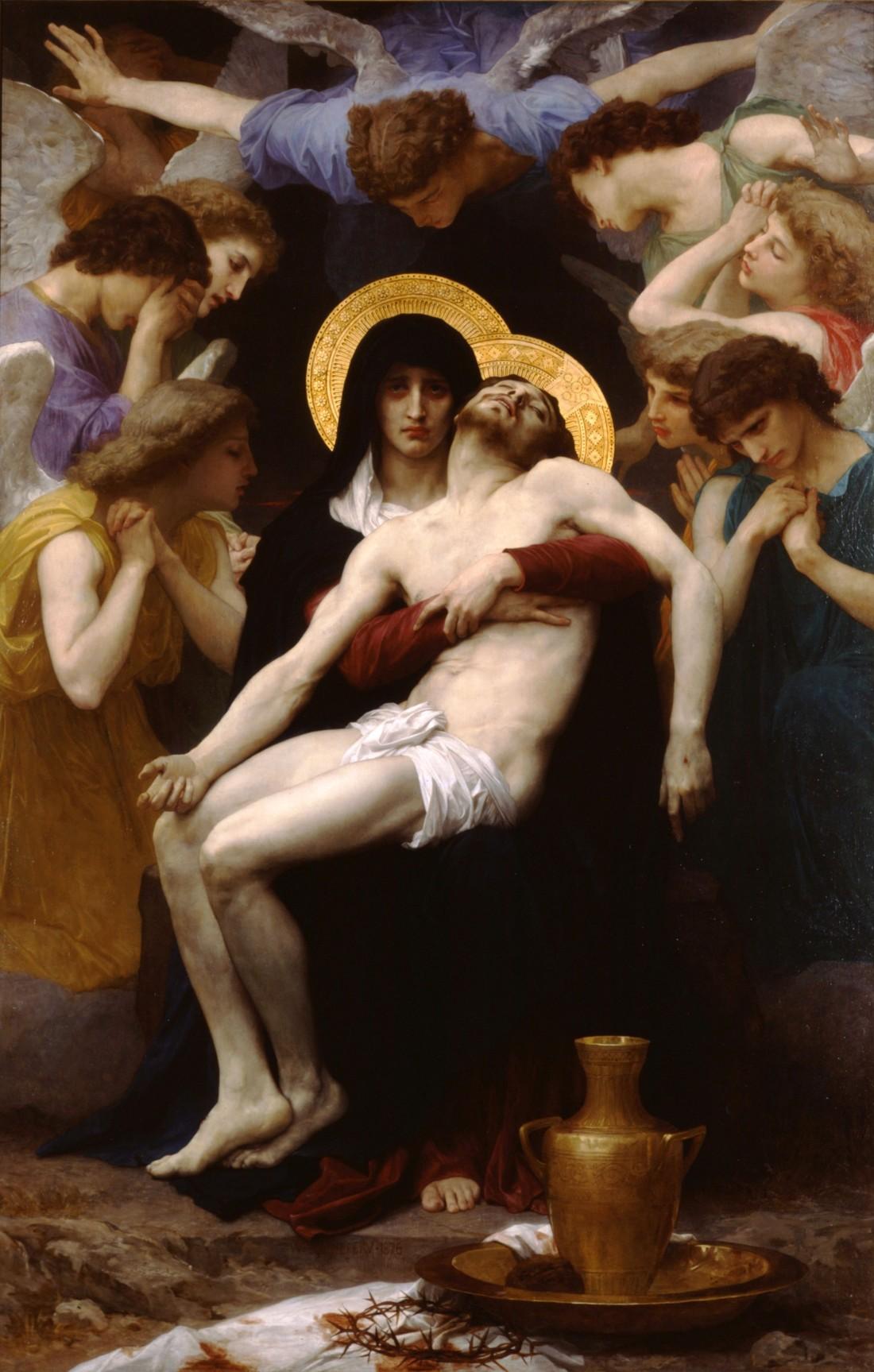
The sorrowful Virgin Mary holds the body of Jesus, surrounded by mourning angels, in Bouguereau’s Pietà
Bouguereau · Pietà · 1876

A devotion of repentance, compassion, and hope

What is the Seven Sorrows Rosary?

The Seven Sorrows Rosary, also called the Servite Rosary or Chaplet of the Seven Dolors, joins meditation on Our Lady’s sorrows with one Our Father and seven Hail Marys at each mystery.

We pray it to draw near to Christ, repent of sin, and learn a more faithful love from His Mother. You can bring a grief of your own or pray for someone else. Tears and a particular feeling are not required.

7Sorrows to contemplate
7Hail Marys at each
3Final Hail Marys

Seven Our Fathers and fifty-two Hail Marys altogether, with the opening Act of Contrition and closing prayer.

The words close at hand

Pray the Seven Sorrows

Follow the opening, each Sorrow, and the conclusion at your own pace. The full prayers remain visible at every group.

Begin with repentance

Act of Contrition

The form printed in The New Raccolta (1903)

Begin with the following Act of Contrition, taken from the historical source used for this chaplet.

O Saviour, my sole and only love! see me before thy divine presence, all confusion by reason of the many grievous injuries I have done thee. With my whole heart I ask thy pardon for them; repenting of them out of pure love for thee, and, at the thought of thy great goodness, hating and loathing them above every other evil of this life. Would that I had died a thousand times ere ever I had offended thee! but now I am most firmly resolved to lose my life a thousand times rather than to offend thee again.

My Jesus crucified, I firmly purpose to cleanse my soul forthwith by thy most precious blood, in the sacrament of penance. And thou, most tender Virgin, mother of mercy, and refuge of the sinner, do thou, by thy bitter pains, obtain for me the pardon of my sins.

Meanwhile, praying, in accordance with the wishes of so many holy Pontiffs, for the indulgences attached to this chaplet, I hope thereby to obtain remission of all the punishment due to my sins.

The last sentence belongs to the 1903 prayer text and reflects the indulgence discipline of that period. It is reproduced for source fidelity, not as a claim about an indulgence available today.

Mystery and prayer, together

Meditate while you pray.

Announce the Sorrow once. Read its traditional meditation, with the optional Gospel passage if you wish, and pause. Then say the Our Father and seven Hail Marys while keeping that mystery in mind.

1 Our Father7 Hail Marys, one on each small bead

One group for one Sorrow. Keep the mystery in mind while praying.

You do not need a new thought for every bead. These are groups of seven, rather than decades of ten. Bead arrangements can vary.

  1. Make the Act of Contrition

    Begin with the Act of Contrition printed in the prayer-text section below.

  2. Meditate on each Sorrow

    Announce the Sorrow and read its traditional meditation. On the large bead, pray one Our Father. Then pray one Hail Mary on each of the next seven small beads while keeping that Sorrow in mind.

  3. Complete all seven Sorrows

    Repeat the same prayer pattern for each of the seven meditations.

  4. Honor Our Lady’s tears

    After the seventh Sorrow, pray three Hail Marys in veneration of the tears shed by the Blessed Virgin Mary in her sorrows.

  5. Pray the conclusion

    Finish with “Pray for us, Virgin most sorrowful,” its response, and the closing prayer printed below.

IndulgencesTraditional grants recorded in 1910

Historical grants; current availability is not established here.

These grants are recorded in the 1910 Raccolta for the seven groups of one Our Father and seven Hail Marys, followed by three Hail Marys. The prayer texts on this page follow the separately cited 1903 edition.

For the grants below, use beads blessed by a Servite priest or another priest with the required special authority. In a group, it is sufficient for the leader to use them. Meditate on the Seven Sorrows while praying; if you are prevented from meditating, you may gain these particular grants by reciting the prayers.

  • 7 years and 7 quarantines each time

    Recite the entire chaplet under the conditions described above.

  • 100 days for each Our Father and Hail Mary

    Complete the entire chaplet under the conditions described above.

  • Plenary once a month

    Recite the chaplet daily for a month under the conditions described above, with confession, Holy Communion, and prayer for the Pope’s intentions.

To receive the indulgence, you must be in a state of grace, intend to gain the indulgence, and devoutly complete the prescribed prayer or work.

To receive the full benefit of a plenary indulgence, you must be sorry for every sin, even venial sin, and free from voluntary attachment to any sin.

Try the first group

One thought can be enough.

Suppose you have just said the opening Act of Contrition. Announce: “The First Sorrow: the Prophecy of Simeon.” Read St. Luke 2:34-35 if you wish, then the traditional meditation. Pause with the thought that Mary hears of a sorrow she cannot yet see in its fullness.

On the large bead, pray the Our Father. On each of the seven small beads, pray one Hail Mary. While saying these prayers, return to the thought of Mary’s fidelity. You might bring before God a responsibility whose future is uncertain, asking for the grace to be faithful today.

If your mind wanders during the fourth Hail Mary, simply return to the mystery and continue. You do not need seven perfectly distinct meditations. The purpose of the beads is to help you keep the count while you pray.

After the seventh Hail Mary, the first group is complete. Announce the Flight into Egypt, read its traditional meditation, and begin its Our Father. You do not add the three concluding Hail Marys until all seven Sorrows have been completed.

From Simeon’s prophecy to the sepulchre

The Seven Sorrows of Our Lady

Read before praying, or return for a fuller study. The explanations and imagined everyday examples are new companion material, separate from the traditional prayer texts.

  1. The Prophecy of Simeon

    Contemplate Mary hearing that a sword of sorrow would pierce her soul.

    Scripture & traditional meditation St. Luke 2:34-35

    34. And Simeon blessed them, and said to Mary his mother: Behold this child is set for the fall, and for the resurrection of many in Israel, and for a sign which shall be contradicted;

    35. And thy own soul a sword shall pierce, that, out of many hearts, thoughts may be revealed.

    Douay-Rheims Bible, Challoner revision. Read the chapter.

    St. Luke records Simeon’s words to Mary at the Presentation. The sword foretells sorrow joined to the mission of her Son. The Gospel gives the prophecy; it does not supply a detailed account of everything Mary thought as she heard it.

    From the 1903 New Raccolta

    With this heartfelt confidence, I meditate on the first dolor, when Mary, virgin mother of my God, presented Jesus, her only-begotten Son, in the temple, laid him in the arms of holy old Simeon, and heard his word of prophecy, "A sword shall pierce thy own soul," which foretold the passion and death of her Son Jesus.

    Page 222. Follow with one Our Father and seven Hail Marys.

    Meaning & an everyday example

    A warning within a promise

    Simeon’s words are addressed to the Mother, but they concern the Son. This Child will be a sign of contradiction. The sword that will pierce Mary’s soul belongs to the history of His coming among us. Her sorrow cannot be understood apart from her love of Jesus.

    The scene takes place in the Temple, where she has brought Him in obedience to the law. An act of worship becomes the occasion of a grave prophecy. Consider the Child in Simeon’s arms and Mary listening. The Gospel does not tell us her reply.

    In prayer, remain with the cost of belonging to Christ. We often want obedience to assure us of an untroubled future. Mary’s first Sorrow places that desire before a different prospect: the Son she loves will be opposed. Ask for love of Him that will endure contradiction.
    The news you carry home

    A father comes home with news that his job may end. At supper his youngest child asks him to fix a toy. He answers impatiently, then sees the child put it away. The threatened loss is still in the future; the hurt he has just caused is already here.

    Simeon’s prophecy gives him something to bring to prayer. Mary hears of the sword when Jesus is presented in the Temple. He can remain with that scene through the seven Hail Marys, asking for help with the fear that has begun to govern his household.

    The toy will still be there when he finishes. So will the child. An apology and a few minutes beside him are a place to begin. Tomorrow may require difficult decisions. Tonight, this father has someone to love.

  2. The Flight into Egypt

    Contemplate Mary carrying the Infant Jesus into exile to escape Herod.

    Scripture & traditional meditation St. Matthew 2:13-15

    13. And after they were departed, behold an angel of the Lord appeared in sleep to Joseph, saying: Arise, and take the child and his mother, and fly into Egypt: and be there until I shall tell thee. For it will come to pass that Herod will seek the child to destroy him.

    14. Who arose, and took the child and his mother by night, and retired into Egypt: and he was there until the death of Herod:

    15. That it might be fulfilled which the Lord spoke by the prophet, saying: Out of Egypt have I called my son.

    Douay-Rheims Bible, Challoner revision. Read the chapter.

    St. Matthew describes the angel’s warning to Joseph and the journey into Egypt. The narrative speaks plainly of danger, departure, and refuge. It does not give the conversations of the Holy Family along the way.

    From the 1903 New Raccolta

    The second dolor of the blessed Virgin was when she had to fly into Egypt on account of the persecution of cruel Herod, who impiously sought to slay her well-beloved Son.

    Page 223. Follow with one Our Father and seven Hail Marys.

    Meaning & an everyday example

    The Child whom Joseph protects

    The Son of God is carried out of danger as a little Child. St. Matthew tells the story through Joseph’s obedience: he receives the warning, rises, takes the Child and His Mother, and departs by night. Mary shares the journey and the exile of her Son.

    Consider the humility of the Incarnation. Our Saviour has entered a human household. The care of Joseph and Mary belongs to His earthly life, and a ruler’s violence drives that household from its home. The Gospel gives us enough to contemplate: Joseph’s obedience, the departure by night, and the Holy Family’s exile.

    Bring before Christ those whose homes are unsafe and those charged with protecting them. Joseph’s departure gives this prayer a practical seriousness. When a vulnerable person is entrusted to us, love may require an inconvenient and decisive act.

    A place at the table

    A family has arrived with more bags than furniture. Their children do not know the neighbourhood. Even the ordinary business of finding food, transport, and a place to sleep has become unfamiliar.

    Consider the Flight into Egypt from the position of someone who could offer shelter. Would you notice the newcomers? Would your questions serve their needs, or merely satisfy your curiosity? Joseph takes the Child and His Mother out of danger. The people who meet a displaced family have their own decisions to make.

    During this Sorrow, remember a household far from home. If you know such a family, ask what would be useful. A place at the table can be offered without requiring the story of how they came to need it.

  3. The Loss of Jesus for Three Days

    Contemplate the sorrowful search of Mary and St. Joseph before finding Jesus in the Temple.

    Scripture & traditional meditation St. Luke 2:46, 48-50

    46. And it came to pass, that, after three days, they found him in the temple, sitting in the midst of the doctors, hearing them, and asking them questions.

    48. And seeing him, they wondered. And his mother said to him: Son, why hast thou done so to us? behold thy father and I have sought thee sorrowing.

    49. And he said to them: How is it that you sought me? did you not know, that I must be about my father’s business?

    50. And they understood not the word that he spoke unto them.

    Douay-Rheims Bible, Challoner revision. Read the chapter.

    Selected verses from the finding in the Temple. For the full account, read St. Luke 2:41-52. Not understanding His saying does not imply sin.

    From the 1903 New Raccolta

    The third dolor of the blessed Virgin was when, after having gone up to Jerusalem, at the Passover, with Joseph, her spouse, and Jesus, her beloved Son, she missed him while returning to her humble dwelling, and for three days bewailed the loss of her sole-beloved one.

    Page 223. Follow with one Our Father and seven Hail Marys.

    Meaning & an everyday example

    His Father’s business

    Mary’s words make the sorrow of the search plain: she and Joseph have sought Jesus sorrowing. His reply turns their attention to His Father. St. Luke then says that they did not understand the saying He spoke to them.

    Read the whole passage, St. Luke 2:41-52, when you can. The finding leads back to Nazareth, where Jesus is subject to them and Mary keeps these things in her heart. The mystery holds together His divine mission and the hidden obedience of His family life.

    The Third Sorrow concerns Mary’s loss and search, rather than a fault attributed to her. In our meditation, it can awaken a desire to seek Christ more earnestly. Ask what place He has in your life when other concerns become urgent. Do you return to Him only after everything else has been attended to?

    The prayer you almost leave unsaid

    The book is open, but you have read the same line three times. Yesterday’s argument returns. Then tomorrow’s work. You remember a time when prayer seemed easy and wonder what has happened to you.

    In the Third Sorrow, stay with the search. Mary and Joseph go back to Jerusalem; they seek Jesus and find Him in the Temple. Their question is spoken out of sorrow, and His answer is not yet understood. St. Luke allows both the finding and the incomprehension to stand.

    You can finish the prayer before you have explained your own dryness. If there is a fault to confess, confess it. If you need counsel, seek it. For these seven Hail Marys, give your attention to Jesus being sought and found. Return to Him each time you discover that your thoughts have wandered.

  4. Mary Meets Jesus Carrying the Cross

    Contemplate Mother and Son meeting on the road to Calvary.

    Scripture & traditional meditation St. John 19:16-17

    16. Then therefore he delivered him to them to be crucified. And they took Jesus, and led him forth.

    17. And bearing his own cross, he went forth to that place which is called Calvary, but in Hebrew Golgotha.

    Douay-Rheims Bible, Challoner revision. Read the chapter.

    St. John narrates Jesus carrying His Cross to Golgotha. He does not describe a meeting with His Mother on the road. That meeting is a traditional devotional scene, expressed in the Fourth Sorrow and the Stations of the Cross.

    From the 1903 New Raccolta

    The fourth dolor of the blessed Virgin was when she met her most loving Son, Jesus, carrying on his tender shoulders the heavy cross, whereon he was to be crucified for our salvation.

    Page 223. Follow with one Our Father and seven Hail Marys.

    Meaning & an everyday example

    Mother and Son on the road

    Consider whom Mary sees: the Son she bore, tended, and sought, now going to His Crucifixion. The earlier Sorrows have led toward this road. Simeon’s prophecy is no longer a distant warning. Her love is directed toward the same Jesus whom she received in joy.

    The chaplet does not give their words to one another. Let the meeting remain quiet. Adore Our Lord as He goes to His Passion, and ask His Mother to pray for you. If you bring someone else’s suffering to this group, place that person before Him without losing sight of the mystery itself.

    At a friend’s door

    He has been meaning to visit since the funeral. Each day he postpones it. He cannot think what to say to a man whose wife has died, and he fears the silence that might follow his greeting.

    The Fourth Sorrow gives him a meeting to contemplate. The chaplet places Mary before her Son on the road to Calvary. It supplies no conversation for him to memorize. He can attend to the love of Mother and Son without filling the scene with words.

    When he calls his friend, he can ask whether a visit would be welcome. Once there, he may hear the same memory more than once. He may sit for a while without speaking. His friend has lost someone irreplaceable. The visitor’s task is smaller: to come, to listen, and to remember to come again.

  5. The Crucifixion and Death of Jesus

    Contemplate Mary standing beneath the Cross as her Son gives His life for the world.

    Scripture & traditional meditation St. John 19:25-27, 30

    25. Now there stood by the cross of Jesus, his mother, and his mother’s sister, Mary of Cleophas, and Mary Magdalen.

    26. When Jesus therefore had seen his mother and the disciple standing whom he loved, he saith to his mother: Woman, behold thy son.

    27. After that, he saith to the disciple: Behold thy mother. And from that hour, the disciple took her to his own.

    30. Jesus therefore, when he had taken the vinegar, said: It is consummated. And bowing his head, he gave up the ghost.

    Douay-Rheims Bible, Challoner revision. Read the chapter.

    St. John explicitly names the Mother of Jesus at the Cross. These selected verses record Our Lord’s words to His Mother and the disciple, and His death. Read St. John 19:18-30 for the larger passage.

    From the 1903 New Raccolta

    The fifth dolor of the blessed Virgin was when she saw her Son, Jesus raised upon the tree of the cross, and all his sacred body pour forth blood; and then, after three long hours of agony, beheld him die.

    Page 223. Follow with one Our Father and seven Hail Marys.

    Meaning & an everyday example

    Beside the Cross of Jesus

    St. John names the Mother of Jesus among those standing at His Cross. He records Our Lord’s words to her and to the beloved disciple. Even in His Passion, Jesus speaks and gives. The disciple receives His Mother into his own care.

    Remain first with Jesus Himself. His Crucifixion is the saving Passion of Our Lord, worthy of adoration and thanksgiving. Mary’s sorrow brings us near to the One who is dying. Her presence keeps the scene personal: this is her Son.

    The Act of Contrition with which the chaplet began can now be recalled in a few words: “O Saviour, my sole and only love!” Ask for a deeper hatred of sin and a grateful love of Him. If repentance requires a change in your conduct, let the purpose be sincere. The mercy you seek is the mercy of Jesus crucified.

    The correction you owe

    You told the story in a way that made your relative look worse. A detail was exaggerated; something that would have explained her conduct was left out. The listeners agreed with you, and their agreement made it harder to admit what you had done.

    Now the Act of Contrition asks for a purpose of amendment. At the Fifth Sorrow, the words have a particular claim upon you. Before Jesus crucified, bring the wrong itself into view, including the satisfaction you took in being believed.

    An apology to your relative may be necessary. So may a correction to the people who heard you. Neither requires another account of her faults. Ask for the humility to say plainly what was untrue, and bring the sin honestly to confession.

  6. The Body of Jesus Is Placed in Mary’s Arms

    Contemplate the pierced body of Jesus taken down from the Cross and received by His sorrowful Mother.

    Scripture & traditional meditation St. John 19:38, 40

    38. And after these things, Joseph of Arimathea (because he was a disciple of Jesus, but secretly for fear of the Jews) besought Pilate that he might take away the body of Jesus. And Pilate gave leave. He came therefore, and took the body of Jesus.

    40. They took therefore the body of Jesus, and bound it in linen cloths, with the spices, as the manner of the Jews is to bury.

    Douay-Rheims Bible, Challoner revision. Read the chapter.

    St. John names Joseph of Arimathea in the taking down of Jesus’ body and describes its preparation for burial. He does not state that the body was placed in Mary’s arms. The Pietà is the traditional devotional contemplation used in this Sorrow.

    From the 1903 New Raccolta

    The sixth dolor of the blessed Virgin was when she saw the lance pierce the sacred side of Jesus, her beloved Son, and then received his holy body taken down from the cross and laid in her stainless bosom.

    Page 223. Follow with one Our Father and seven Hail Marys.

    Meaning & an everyday example

    The Son she once held as a Child

    The Pietà places the dead Christ in His Mother’s arms. It recalls, by a sorrowful resemblance, the Child she once held. The body received at the end of His earthly life is the body of the Son she bore.

    Attend to the reverence of the scene. Human hands receive and tend the body of Our Lord. Love still has work to do after His death. As you pray, ask for tenderness toward the dying and reverence toward the dead. Remember those whose care is carried out quietly, when few people are present to notice it.

    The familiar task

    A daughter washes her elderly father’s hands. It is a task she has done many times. Today she is tired, and there are messages waiting on her phone. He begins a story she has heard before.

    The Sixth Sorrow may return to her in this ordinary work: the body of Jesus taken down from the Cross, and the traditional contemplation of His Mother receiving Him. Care is personal. The hands she washes belong to her father, who once held hers.

    She can slow down enough to hear him. Later she may need someone to take her place so that she can rest. For now, there is water to change, a towel to bring, and a person before her. Reverence can inhabit these familiar movements.

  7. The Burial of Jesus

    Contemplate Mary accompanying the body of her Son to the tomb.

    Scripture & traditional meditation St. John 19:41-42

    41. Now there was in the place where he was crucified, a garden; and in the garden a new sepulchre, wherein no man yet had been laid.

    42. There, therefore, because of the parasceve of the Jews, they laid Jesus, because the sepulchre was nigh at hand.

    Douay-Rheims Bible, Challoner revision. Read the chapter.

    St. John describes the garden, the new sepulchre, and the laying of Jesus’ body there. He does not explicitly name Our Lady as present at the burial. The chaplet invites us to contemplate her sorrow at her Son’s entombment.

    From the 1903 New Raccolta

    The seventh and last dolor of the blessed Virgin, queen and advocate of us, her servants, miserable sinners, was when she saw the holy body of her Son laid in the sepulchre.

    Page 223. Follow with one Our Father and seven Hail Marys.

    Meaning & an everyday example

    The body laid in the sepulchre

    St. John gives us a garden and a new sepulchre near the place of Crucifixion. There they lay Jesus. Contemplate His Mother’s sorrow as His body is laid in the tomb.

    Allow the burial its place in your prayer. Our Lord truly died and was buried. The Christian who contemplates this mystery believes in His Resurrection, but does not have to pass over the tomb as though death and separation were slight things.

    Pray for the dead and for those who mourn them. We commend particular souls to God’s mercy rather than claiming knowledge of their eternal state. At the end of the seven Sorrows, the closing prayer asks Our Lord for mercy now and at the hour of our death. Let the meditation prepare you to make that petition with trust.

    When the house grows quiet

    The visitors have gone home. The flowers are fading. A widow finds that the hours once occupied by caring for her husband now seem very long. Other people have returned to their routines; she is learning a house altered by his absence.

    The Seventh Sorrow gives those who love her a reason to remember after the funeral week. Jesus is laid in the sepulchre. The chaplet asks us to contemplate His Mother’s sorrow at that burial. We need not hurry this mystery toward a lesson that will make bereavement easy.

    Pray for the man who has died. Remember his wife when the first offers of help have ceased. Write his anniversary down. A letter months later, using his name and recalling something good about him, may be a kindness that she keeps.

Cover of the free eight-page Seven Sorrows prayer guide

Free to download and print

A short guide for your beads

Eight pages with the complete prayer order, opening and closing prayers, all seven Sorrows, and a labeled bead diagram.

Download the prayer guide ↓

Download the fold-and-print version

8 pages · Black and white · No purchase required. The folded version uses two sheets of Letter paper, printed on both sides.

Read the full companion free

The history, explanations, prayers, and meditations are all available online.

Read The Seven Sorrows of Our Lady →

Keep a printed companion

Cover of The Seven Sorrows of Our Lady

The 50-page book brings the longer readings and full prayers together in a bound edition for your prayer bag or bedside.

Online ordering for the printed edition is not available here yet.

A rosary and its companion

We plan to offer a matching Seven Sorrows rosary with the printed book, packaged together and sold directly through Novena Regina.

Rosary sets are not yet available. You can begin praying now with the free guide.

The complete texts

All the prayers, together

The 1903 form is complete without adding a Glory Be or Stabat Mater verse after each group.

Act of Contrition from the 1903 source

O Saviour, my sole and only love! see me before thy divine presence, all confusion by reason of the many grievous injuries I have done thee. With my whole heart I ask thy pardon for them; repenting of them out of pure love for thee, and, at the thought of thy great goodness, hating and loathing them above every other evil of this life. Would that I had died a thousand times ere ever I had offended thee! but now I am most firmly resolved to lose my life a thousand times rather than to offend thee again.

My Jesus crucified, I firmly purpose to cleanse my soul forthwith by thy most precious blood, in the sacrament of penance. And thou, most tender Virgin, mother of mercy, and refuge of the sinner, do thou, by thy bitter pains, obtain for me the pardon of my sins.

Meanwhile, praying, in accordance with the wishes of so many holy Pontiffs, for the indulgences attached to this chaplet, I hope thereby to obtain remission of all the punishment due to my sins.

The last sentence belongs to the 1903 prayer text and reflects the indulgence discipline of that period. It is reproduced for source fidelity, not as a claim about an indulgence available today.

The Our Father

Our Father, Who art in heaven, hallowed be Thy name. Thy kingdom come; Thy will be done on earth, as it is in heaven.

Give us this day our daily bread; and forgive us our trespasses, as we forgive those who trespass against us. And lead us not into temptation; but deliver us from evil. Amen.

F. X. Lasance, With God (1911), p. 153.

The Hail Mary

Hail Mary, full of grace, the Lord is with thee; blessed art thou among women, and blessed is the fruit of thy womb, Jesus.

Holy Mary, Mother of God, pray for us sinners, now and at the hour of our death. Amen.

F. X. Lasance, With God (1911), p. 153.

Closing versicle and prayer

After the seventh Sorrow, pray three more Hail Marys. Then say both the verse and response when praying alone.

V. Pray for us, Virgin most sorrowful.

R. That we may be made worthy of the promises of Christ.

Let us pray.

Grant, we beseech thee, O Lord Jesus Christ, that the most blessed Virgin Mary, thy mother, may intercede for us before the throne of thy mercy, now, and at the hour of our death, through whose most holy soul, in the hour of thine own passion, the sword of sorrow passed. Through thee, Jesus Christ, Saviour of the world, who livest and reignest, with the Father and the Holy Ghost, for ever and ever. Amen.

Practical answers

Learning the chaplet

Do I meditate while saying the prayers?

Yes. Announce the Sorrow once, consider it briefly, then pray one Our Father and seven Hail Marys while keeping that mystery in mind. You may read a passage beforehand. You do not need to recite a separate meditation on every bead.

Are these groups called decades?

A decade means ten Hail Marys. This chaplet has seven groups of seven Hail Marys, one group for each Sorrow. The Sorrow is the mystery you contemplate; the group is the set of prayers you say.

How many Hail Marys are there?

Forty-nine in the seven groups, plus three offered in veneration of Our Lady’s tears. That gives fifty-two Hail Marys, together with seven Our Fathers, the opening Act of Contrition, and the conclusion.

Do I add a Glory Be?

The 1903 New Raccolta form followed here does not prescribe a Glory Be after each Sorrow. Other customs may add prayers or Stabat Mater verses; this guide keeps the selected source order intact.

Can I use an ordinary rosary?

Yes, as a counting aid. Count only seven Hail Marys in each group, skip the remaining three small beads, and move to the next large bead. After five groups, return to the loop for the sixth and seventh. Add the three closing Hail Marys separately.

Do all seven scenes appear explicitly in Scripture?

The Gospel readings and the traditional meditations are identified separately. The meeting with Mary on the road and the placing of Jesus’ body in her arms are not explicitly narrated in the Gospels. The burial passage does not explicitly name His Mother as present.

Must I read every note or feel sorrowful?

No. The notes are optional aids for study and prayer. You can stay with one simple thought throughout a group. The devotion asks for reverence, repentance, and charity; it does not require tears or a particular emotion.

A tradition you can trace

The Servites and the Seven Sorrows

The Servite beginnings

The devotion belongs to a larger history of Christian remembrance of Mary’s compassion in the Passion of Christ. The Servite Order gave this remembrance a special place in its life. Its name means Servants of Mary; devotion to the Mother of God, especially in her sorrows, became a characteristic part of its work.

The Catholic Encyclopedia’s 1912 account traces the Order to seven men of Florence who belonged to a Marian association. It places their beginning in 1233 and describes their withdrawal from city life, first near Florence and later at Monte Senario. Their common religious life grew into an order that preached and served the faithful.

The Order’s beginning should be distinguished from the development of the chaplet. The same 1912 article names the Rosary of the Seven Dolours among Servite devotions and records a confraternity of the Seven Dolours. The precise prayer form used in this companion is documented in the 1903 New Raccolta.

A devotion handed down

Devotion to the sorrowful Mother developed through prayer, preaching, sacred art, and the Church’s commemorations. The older Catholic Encyclopedia article on the feasts of the Seven Sorrows records differing local observances and even arrangements of five or seven sorrows. The familiar sevenfold pattern has a history; it did not appear everywhere in one fixed form at once.

For the prayer order in this book, we have a precise printed witness: The New Raccolta of 1903, pages 222 to 224. It supplies the Act of Contrition, seven meditations with one Our Father and seven Hail Marys each, three further Hail Marys, and the conclusion. Pages 224 to 226 discuss the indulgences of that period.

Some prayer books include further invocations, verses of the Stabat Mater, or a Glory Be between groups. Here the complete 1903 sequence is followed throughout. The additional readings and reflections are identified separately, so you can use them for study and return to the prayer pages for recitation.

About this edition and its source texts

The prayer order, Act of Contrition, seven traditional meditations, and closing prayer follow The New Raccolta (1903), pages 222 to 224. Its historical indulgence material continues through page 226. The introductions, explanations, examples, and reflections in this companion are newly written editorial aids. They are optional and are not part of the source prayers.

This private devotional compilation carries no ecclesiastical imprimatur. Approval attached to a historical source does not constitute approval of this new companion.

The last sentence belongs to the 1903 prayer text and reflects the indulgence discipline of that period. It is reproduced for source fidelity, not as a claim about an indulgence available today.

Older editions record indulgences that belonged to their period. The Church revised indulgence discipline in 1967, so this guide does not present those older grants as current.

The traditional meditations for the fourth, sixth, and seventh Sorrows include scenes or details not explicitly stated in the selected Gospel passages. The notes identify these distinctions.