The Rosary of the Seven Joys
The Franciscan
Crown
Rejoice with Our Lady.
Seven decades of prayer. Seven joys in the life of the Blessed Virgin Mary. A quiet way to draw near to Christ with His Mother.
Traditional prayers · From an 1869 Franciscan manual

A crown woven from prayer
Seven joys. One loving offering.
The Franciscan Crown, also called the Seraphic Rosary, is a seven-decade rosary in honor of Our Lady’s Seven Joys. Hold each mystery in your heart as you pray. Begin here, or keep the little booklet beside your beads.
Then one Our Father and one Hail Mary for the Sovereign Pontiff, followed by the closing prayer.
A little quiet. A place to begin.
Pray the Crown
Follow the opening, the Seven Joys, and the closing prayers at your own pace.
Gather your intentions
Begin the Crown
Bring to mind those for whom you wish to pray. Begin with these versicles, followed by one Glory Be.
V. O God, come to my assistance.
R. O Lord, make haste to help me.
Glory Be to the Father
Glory be to the Father, and to the Son, and to the Holy Ghost.
As it was in the beginning, is now, and ever shall be, world without end. Amen.
Then announce the first Joy and begin its decade.
Learn the prayer
Follow the beads
Each large bead begins a new Joy. Each group of ten small beads carries its decade.
One decade. Pray the Glory Be after the ten Hail Marys.
This diagram shows the prayer sequence for one decade. Bead arrangements can vary.
Pray the opening versicles
Pray “O God, come to my assistance,” with its response, and then pray one Glory Be.
Pray the seven decades
Announce each Joy once. Then meditate on that Joy while praying one Our Father on the large bead and ten Hail Marys, one on each small bead. Finish with one Glory Be.
Complete the seventy-two Hail Marys
After the seventh decade, pray two additional Hail Marys. This brings the Crown itself to seventy-two Hail Marys.
Pray for the Sovereign Pontiff
Pray one Our Father and one Hail Mary for the Sovereign Pontiff.
Pray the conclusion
Finish with the versicle and response about the Immaculate Conception, followed by the closing prayer printed below.
From Nazareth to Heaven
The Seven Joys of Our Lady
Announce one Joy before each decade. The titles and their order follow the 1869 manual.
The Annunciation and Divine Maternity
Rejoice with Mary at the message of the angel and the Incarnation of the Son of God.
Read & meditate St. Luke 1:26-28, 38
26. And in the sixth month, the angel Gabriel was sent from God into a city of Galilee, called Nazareth,
27. To a virgin espoused to a man whose name was Joseph, of the house of David; and the virgin’s name was Mary.
28. And the angel being come in, said unto her: Hail, full of grace, the Lord is with thee: blessed art thou among women.
38. And Mary said: Behold the handmaid of the Lord; be it done to me according to thy word. And the angel departed from her.
Douay-Rheims Bible, Challoner revision
Mary receives the word of God with humility and obedience. The angel’s greeting leads to her willing consent. As you pray this decade, consider her readiness to accept what God asks of her, and ask for the grace to do His will in the duties of your own life.
The Visitation
Rejoice with Mary as she visits St. Elizabeth and carries Christ into her home.
Read & meditate St. Luke 1:41-45
41. And it came to pass, that when Elizabeth heard the salutation of Mary, the infant leaped in her womb. And Elizabeth was filled with the Holy Ghost:
42. And she cried out with a loud voice, and said: Blessed art thou among women, and blessed is the fruit of thy womb.
43. And whence is this to me, that the mother of my Lord should come to me?
44. For behold as soon as the voice of thy salutation sounded in my ears, the infant in my womb leaped for joy.
45. And blessed art thou that hast believed, because those things shall be accomplished that were spoken to thee by the Lord.
Douay-Rheims Bible, Challoner revision
Elizabeth greets Mary as the mother of her Lord. Their meeting is filled with the joy of Christ’s presence. Consider the charity of Our Lady and the happiness she brings to this household. Bring before God the people you visit, care for, and serve.
The Birth of Jesus
Rejoice with Mary at Bethlehem and adore the Infant Christ.
Read & meditate St. Luke 2:6-7, 10-11
6. And it came to pass, that when they were there, her days were accomplished, that she should be delivered.
7. And she brought forth her firstborn son, and wrapped him up in swaddling clothes, and laid him in a manger; because there was no room for them in the inn.
10. And the angel said to them: Fear not; for, behold, I bring you good tidings of great joy, that shall be to all the people:
11. For, this day, is born to you a Saviour, who is Christ the Lord, in the city of David.
Douay-Rheims Bible, Challoner revision
The Saviour is laid in a manger. His coming brings great joy in the midst of poverty and simplicity. Consider Mary’s love for her newborn Son. Adore Christ with her, and make room for Him in the ordinary circumstances of your life.
The Adoration of the Magi
Rejoice as the nations come to worship the newborn King.
Read & meditate St. Matthew 2:10-11
10. And seeing the star they rejoiced with exceeding great joy.
11. And entering into the house, they found the child with Mary his mother, and falling down they adored him; and opening their treasures, they offered him gifts; gold, frankincense, and myrrh.
Douay-Rheims Bible, Challoner revision
The wise men find the Child with Mary His mother. Their search ends in adoration, and they open their treasures before Him. Consider the joy of Our Lady as Christ is worshipped. Offer Him your time, your work, and the love with which you do small things.
The Finding of Jesus in the Temple
Rejoice with Mary and St. Joseph when they find Jesus after three days of searching.
Read & meditate St. Luke 2:46-47, 51
46. And it came to pass, that, after three days, they found him in the temple, sitting in the midst of the doctors, hearing them, and asking them questions.
47. And all that heard him were astonished at his wisdom and his answers.
51. And he went down with them, and came to Nazareth, and was subject to them. And his mother kept all these words in her heart.
Douay-Rheims Bible, Challoner revision
After three days of sorrowful searching, Mary and Joseph find Jesus in the Temple. He returns with them to Nazareth, and Mary keeps His words in her heart. Consider her joy in finding Him, and ask for perseverance in seeking Christ when prayer feels difficult.
The Resurrection of Her Divine Son
Rejoice in Christ’s victory over death and the joy it brings to His Blessed Mother.
Read & meditate St. Luke 24:5-7
5. And as they were afraid, and bowed down their countenance towards the ground, they said unto them: Why seek you the living with the dead?
6. He is not here, but is risen. Remember how he spoke unto you, when he was in Galilee,
7. Saying: The Son of man must be delivered into the hands of sinful men, and be crucified, and the third day rise again.
Douay-Rheims Bible, Challoner revision
The empty sepulchre announces Christ’s victory over death. The Crown invites us to rejoice with His Blessed Mother in the Resurrection of her Divine Son. This Gospel passage describes the women at the tomb; it does not describe an appearance of the risen Christ to Mary.
The Assumption of Our Lady
Rejoice that Mary is taken into Heaven, body and soul.
Read & meditate Pius XII, Munificentissimus Deus (1950), §44
“having completed the course of her earthly life, was assumed body and soul into heavenly glory.”
Definition of the Assumption
The final Joy honors Our Lady’s Assumption, body and soul, into Heaven. Rejoice in the glory God has given His Mother, and ask for the grace to persevere in His friendship. The Assumption is received through Sacred Tradition; the Gospels do not narrate this event.
Free to download and print
A short guide for your beads
Eight pages with the complete 1869 prayer order, all seven Joys, the full common prayers, and a labeled bead diagram.
Download the fold-and-print version
8 pages · Black and white · No purchase required. The folded version uses two sheets of Letter paper, printed on both sides.
Read the complete companion free
The 24-page companion includes the Crown’s history, explanations, full prayers, readings, and meditations. It is longer than the free eight-page prayer guide above.
Read the complete Franciscan Crown companion
Prefer a bound paperback?
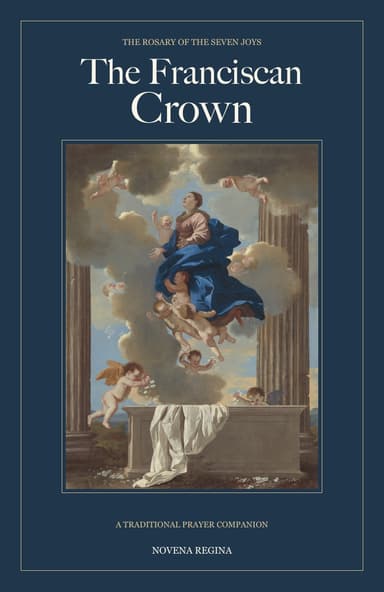
The Franciscan Crown paperback is listed on Amazon. Our book page has its contents, source notes, and a link to the Amazon listing.
See paperback details and the Amazon link
Planned booklet and rosary options
When direct ordering opens, we plan to offer the Franciscan Crown booklet and rosary separately or together as a set.
These direct-sale options are not available yet. The prayer guide and complete online companion remain free.
The words of the prayer
All the prayers, together
Use these texts whenever you need them. The booklet includes them too.
Opening versicles
V. O God, come to my assistance.
R. O Lord, make haste to help me.
Pray one Glory Be.
The Our Father
Our Father, Who art in heaven, hallowed be Thy name. Thy kingdom come; Thy will be done on earth, as it is in heaven.
Give us this day our daily bread; and forgive us our trespasses, as we forgive those who trespass against us. And lead us not into temptation; but deliver us from evil. Amen.
F. X. Lasance, With God (1911), p. 153.
The Hail Mary
Hail Mary, full of grace, the Lord is with thee; blessed art thou among women, and blessed is the fruit of thy womb, Jesus.
Holy Mary, Mother of God, pray for us sinners, now and at the hour of our death. Amen.
F. X. Lasance, With God (1911), p. 153.
Glory Be to the Father
Glory be to the Father, and to the Son, and to the Holy Ghost.
As it was in the beginning, is now, and ever shall be, world without end. Amen.
F. X. Lasance, With God (1911), p. 163.
Closing versicle and prayer
V. In thy Conception, O Virgin Mary, thou wast immaculate.
R. Pray for us to the Father, whose Son thou didst bring forth.
O God, who didst prepare for Thy Son a worthy habitation, by the Immaculate Conception of the Blessed Virgin Mary, we beseech Thee that, as Thou didst preserve her from every stain of sin, through the merits of the preordained atonement of Jesus Christ, so Thou wouldst grant that we also may come without spot to Thee. Through the same Christ our Lord. Amen.
A few helpful answers
New to the Crown?
Is the free prayer guide the same as the complete companion?
No. The eight-page prayer guide is a short aid for following the beads, with the prayer order, Seven Joys, full common prayers, and a bead diagram. The complete 24-page companion adds history, readings, meditations, and source notes. You can download and print the short guide or read the full companion online free; no purchase is required.
What is a decade?
A decade is a group of ten Hail Marys. In this form of the Franciscan Crown, each decade begins with one Our Father and ends with one Glory Be. There are seven decades, one for each Joy.
Why are there seventy-two Hail Marys?
The seven decades contain seventy Hail Marys. Two more complete the Crown’s seventy-two. Older sources connect this number with a traditional belief about the length of Mary’s earthly life; it is not a defined teaching about her age. The further Hail Mary for the Sovereign Pontiff is separate, so the complete 1869 order contains seventy-three Hail Marys altogether.
Can I pray it with an ordinary rosary?
Yes. Pray the first five decades on your rosary, then return to the beginning of the loop for the sixth and seventh Joys. After the seventh decade, add the two Hail Marys, the prayers for the Sovereign Pontiff, and the closing prayer. A seven-decade Franciscan rosary makes it easier to follow the whole Crown once around.
Why does another guide give different prayers?
Historical Franciscan sources preserve more than one form. This companion follows the complete 1869 order, including a Glory Be after every decade. The 1908 Catholic Encyclopedia describes another opening and concludes its list of Joys with the Assumption and Coronation. The prayer sequence here keeps to the 1869 manual.
Rooted in tradition
History and sources
The 1869 Franciscan manual places its traditional origin around 1420. It tells of a young novice who had crowned a statue of Our Lady with flowers. When he could no longer keep this custom, Mary is said to have appeared to him and taught him to offer a crown of prayers in its place.
The prayer order and the opening and closing texts follow the Manual of the Third Order of St. Francis of Assisi (1869), pages 305 to 307. The readings and short companion notes are provided to help meditation; they are not additional prayers required by that manual.
About the form of prayer used here
This guide follows the 1869 Franciscan manual from beginning to end. A 1908 Catholic Encyclopedia account gives a different opening and places each Joy within the first Hail Mary of its decade. It also does not list a Glory Be after each decade. Those historical variations are not mixed into this version.
Older editions record indulgences that belonged to their period. The Church revised indulgence discipline in 1967, so this guide does not present those older grants as current.
The short companion notes are newly written editorial aids. The traditional prayers are reproduced from the sources listed here. The Scripture selections use the Douay-Rheims Bible, Challoner revision. The seventh reading quotes the definition of the Assumption given by Pius XII in 1950.
- Manual of the Third Order of St. Francis of Assisi (1869), pages 305 to 307.Primary prayer source
- Catholic Encyclopedia, “Franciscan Crown” (1908).Historical corroboration
- Paul VI, Indulgentiarum Doctrina (1967).Current indulgence discipline
- F. X. Lasance, With God (1911), pages 153 and 790.Our Father, Hail Mary, and Glory Be
- Pius XII, Munificentissimus Deus (1950), §44.The Assumption
- Nicolas Poussin, The Assumption of the Virgin, c. 1630/1632.National Gallery of Art, Washington. Ailsa Mellon Bruce Fund. CC0 public-domain dedication.
